The Blind-Spot Collision-Avoidance Assist in your Kia Carnival provides comprehensive protection through the
following operational modes:
Type A
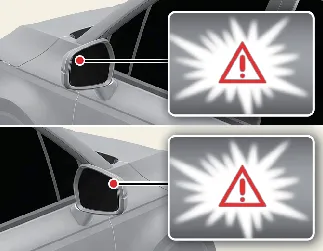
The Blind-Spot Collision-Avoidance Assist (BCA) system in your Kia Carnival provides integrated alerts. If a vehicle
is detected approaching from the rear in either adjacent lane, a warning light will appear on the instrument cluster,
the corresponding outside rear-view (side-view) mirror, and the Head-Up Display (if equipped).
The system actively detects vehicles under the following driving conditions:
When the system is actively monitoring, it provides an intelligent collision warning if you activate your turn signal
to initiate a lane change while another vehicle is sensed in your blind spot.
-
The collision warning alerts the driver through a combination of visual signals on the Kia Carnival instrument
cluster, side-view mirrors, and Head-Up Display, supplemented by an audible chime and haptic steering wheel
vibration.
-
The alert will automatically deactivate once the turn signal is turned off or if your Kia Carnival successfully
clears the path and moves away from the encroaching vehicle, returning the system to its standard monitoring
state.
The Collision Warning feature for active lane changes operates under these specific parameters:
 WARNING
-
The detection range of the Kia Carnival rear corner radar sensors is calibrated for standard road widths. On
exceptionally narrow roads, the system may inadvertently detect vehicles in the second lane over and trigger a
warning. Conversely, on very wide roads, the sensors might fail to detect a vehicle traveling in the immediate
adjacent lane.
-
Note that if the hazard warning flashers are activated, the specific turn-signal-based collision warning will
not operate.
 NOTICE
-
Depending on the regional configuration of your Kia Carnival (left-hand vs. right-hand drive), collision
warnings may be more sensitive when turning toward the side of the driver's seat. Always maintain a safe,
proper distance from vehicles in adjacent lanes.
-
Please be aware that the visual icons and color schemes displayed may differ based on your Kia Carnival
instrument cluster theme or specific hardware version.
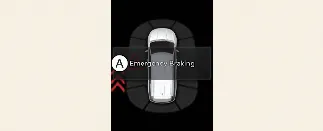
To ensure maximum safety when leaving a parking space or merging into traffic, the Kia Carnival employs an advanced
Collision-Avoidance Assist system. If the system detects a high risk of collision with a vehicle approaching from the
blind spot, it warns the driver through a combination of flashing lights on the outside rear-view (side-view)
mirrors, Head-Up Display (if equipped) alerts, audible chimes, and tactile steering wheel vibrations. If the risk
persists, the Kia Carnival will automatically apply braking control to help prevent an impact.
The Collision-Avoidance Assist (while departing) feature activates under the following conditions:

A: Drive carefully
In the event that the system triggers emergency braking to avoid a collision, a warning message will appear on the
instrument cluster of your Kia Carnival. For your safety, and to maintain control of the vehicle, you should
immediately depress the brake pedal and visually check your surroundings to ensure the path is clear before
proceeding.
 WARNING
-
For your safety and the safety of others, always adjust your Kia Carnival system settings only after parking
the vehicle in a safe and secure location.
-
If warning messages or alerts from other vehicle systems are simultaneously active, the Blind-Spot
Collision-Avoidance Assist (BCA) warning may be suppressed; therefore, do not rely solely on this feature.
-
In noisy driving environments, the audible warnings for the Blind-Spot Collision-Avoidance Assist may be
difficult to hear. Always maintain moderate audio levels and remain fully attentive to your environment.
-
The system's reaction time and warning effectiveness depend on various factors; therefore, always exercise
caution and maintain full control over the Kia Carnival at all times.
-
Driver Override: Please be aware that the Blind-Spot Collision-Avoidance Assist (BCA) system
in your Kia Carnival may not activate if the driver manually applies the brake pedal to initiate an avoidance
maneuver, as the system recognizes your active control.
-
System Cancellation: While the BCA system is providing automated braking support, this
intervention will be automatically cancelled if the system detects that the driver is aggressively depressing
the accelerator pedal or performing sharp steering inputs, as these actions indicate that you have reassumed
active control of the Kia Carnival.
-
Passenger Safety: Because the Kia Carnival Blind-Spot Collision-Avoidance Assist may trigger
sudden braking, there is a risk of movement for unsecured passengers or loose items within the cabin. For the
safety of all occupants, always ensure that seat belts are fastened and all loose objects are properly secured
inside the vehicle.
-
Basic Braking Integrity: Even in the unlikely event that the Blind-Spot Collision-Avoidance
Assist system experiences a functional impairment, your Kia Carnival will continue to provide full, reliable
braking performance through the standard hydraulic brake system.
-
Operational Limitations: The Blind-Spot Collision-Avoidance Assist is a supplementary system
and cannot prevent collisions in all traffic scenarios. Even when functional, it may not be able to avoid a
collision depending on the severity of the situation or unexpected movements of other vehicles.
-
Environmental Variability: The ability of the BCA system to detect hazards and alert the
driver may be limited by specific road geometries, extreme traffic density, or adverse environmental
conditions.
-
Driver Responsibility: The ultimate responsibility for the safe operation of your Kia Carnival
remains entirely with the driver. Do not rely solely on the Blind-Spot Collision-Avoidance Assist; always
maintain visual awareness of your surroundings and perform manual checks before executing lane changes or
maneuvers.
-
Safety Warning: Never attempt to test the Blind-Spot Collision-Avoidance Assist system using
people, animals, or inanimate objects. Attempting such maneuvers is extremely dangerous and can result in
severe personal injury or even death.
 WARNING
The automated braking control functionality may be restricted or may not operate as intended depending on the current
status of the Kia Carnival Electronic Stability Control (ESC) system.
The system will provide a driver alert (without active braking assistance) only under the following conditions:
-
The Electronic Stability Control (ESC) warning light is currently illuminated on the instrument cluster,
indicating a system fault.
-
The Electronic Stability Control (ESC) system is currently prioritized or engaged by a different driver
assistance function.