Front
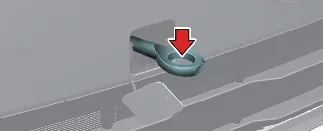
Rear

If professional roadside assistance is required, we strongly recommend that you have your Kia Carnival towed by an
authorized Kia dealer or a certified commercial tow truck service. This ensures the highest level of safety and
prevents unnecessary damage to your vehicle's mechanical systems.
In the event that a professional towing service is unavailable during an emergency, your Kia Carnival may be
temporarily towed using a dedicated tow cable or chain secured exclusively to the emergency towing hook located under
the front or rear bumper. Proceed with extreme caution if you must perform this procedure. A licensed, competent
driver must remain inside the towed Kia Carnival at all times to actively steer the vehicle and manage the brakes,
ensuring the tow line remains taut and the path is clear.
Emergency towing of this nature should only be performed on paved, hard-surfaced roads for a very short distance and
at low, controlled speeds. Before attempting this, perform a quick inspection to ensure that the wheels, axles,
powertrain components, steering system, and brakes are all in safe, working condition.
-
Do not use the emergency towing hooks to pull your Kia Carnival out of mud, deep sand, or snow if the vehicle
is immobilized; attempting to pull an "stuck" vehicle can place excessive force on the chassis and cause
significant structural damage.
-
Always avoid attempting to tow a vehicle that is heavier than the vehicle doing the towing to maintain proper
braking control and steering authority.
-
The drivers of both the towing vehicle and the Kia Carnival should maintain constant communication throughout
the process to coordinate speed, turns, and stops.
 CAUTION
-
Always attach a specialized, high-strength towing strap or cable directly to the factory-installed tow hook.
-
Do not attempt to attach tow lines to bumpers, suspension arms, or any other part of the Kia Carnival body;
doing so will result in costly structural damage to the vehicle.
-
Utilize only cables or chains specifically designed and rated for vehicle recovery. Securely fasten the
equipment to the provided towing hook to ensure it cannot slip or disconnect during operation.
-
During the towing process, both drivers must accelerate and decelerate in a slow, gradual, and predictable
manner. Maintaining constant, gentle tension on the towrope is critical; sudden jerks or slack can snap the
cable and severely damage the towing hooks or the Kia Carnival chassis.
-
Always ensure that the tow line is kept as straight as possible, avoiding sharp turns that could put lateral
stress on the towing hook or the bumper mounting points of your Kia Carnival.
Before initiating any emergency towing sequence for your Kia Carnival, conduct a thorough visual inspection of the
towing hook to ensure it is free from cracks, deformation, or any signs of mechanical fatigue or damage.
Ensure that your professional-grade towing cable or chain is fastened securely and completely to the
factory-designated towing hook point on the Kia Carnival frame.
Never jerk or snatch the tow line. Always apply traction steadily, using even and consistent force to avoid shock
loading the components.
To prevent structural compromise of the hook, never apply pulling force from a side angle or a steep vertical
angle. Always maintain a straight-ahead alignment with the vehicle being towed.
 WARNING
Exercise extreme caution and vigilance at all times when performing an emergency tow for your Kia Carnival.
-
Avoid any sudden, jerky starts or erratic driving maneuvers. Such actions place excessive, dangerous stress on
both the emergency towing hook and the tow line. If these components fail under tension, they can snap back
with extreme force, potentially causing catastrophic structural damage or severe personal injury.
-
If the disabled Kia Carnival remains immobilized despite your efforts, do not attempt to force the vehicle to
move through excessive power. In such scenarios, immediately discontinue the effort and contact an authorized
Kia dealer or a professional commercial tow truck service for specialized recovery assistance.
-
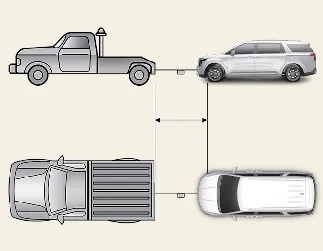
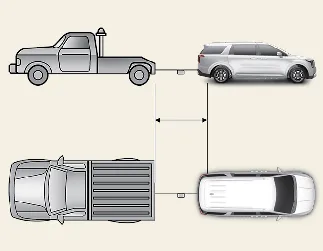
Throughout the duration of the tow, keep the Kia Carnival as straight ahead as possible relative to the towing
vehicle to maximize stability.
-
For safety reasons, ensure all bystanders and pedestrians keep a significant distance away from the Kia
Carnival and the tow line while the vehicle is in motion.
-
Use a certified towing strap with a total length of less than 16 feet (5 m). To enhance safety and visibility
for other road users, firmly attach a bright white or red cloth—approximately 12 inches (30 cm) wide—to the
center of the strap.
-
Drive slowly and modulate your speed carefully to ensure the towing strap remains under constant tension,
preventing it from sagging or loosening during the towing process.
-
A qualified driver must remain inside the Kia Carnival at all times to perform essential steering and braking
functions. For maximum safety, no passengers other than the driver are permitted to remain on board the Kia
Carnival while it is being towed.
Emergency towing precautions
When performing an emergency tow, your Kia Carnival requires specific handling to ensure safety and prevent
mechanical failure. Please adhere to the following professional guidelines:
-
Switch the ignition or move the ENGINE START/STOP button to the ACC (Accessory) position. This is critical to
ensure that the Kia Carnival steering wheel remains unlocked and operational for the driver.
-
Shift the gear selector firmly into the N (Neutral) position.
-
Fully disengage the electronic or manual parking brake.
-
Be prepared to apply the brake pedal with significantly more force than usual, as the power brake booster will
be inactive, resulting in naturally reduced braking performance.
-
Expect substantially heavier steering input, as the electronic power steering system in your Kia Carnival will
be disabled while the engine is off.
-
If you are traversing a long descent, be aware that friction brakes may overheat rapidly, leading to further
degradation of stopping power. Periodically pull over to allow the brake system to cool down completely.
-
To prevent severe internal damage to the automatic transmission of your Kia Carnival, you must strictly limit
your towing speed to no more than 10 mph (15 km/h) and ensure the total travel distance does not exceed 1 mile
(1.5 km).
 CAUTION: Transmission
-
If your Kia Carnival is being towed with all four tires on the road, it must be towed exclusively from the
front. Verify the transmission is in Neutral and the steering is unlocked (ACC position). A qualified driver
must remain inside the vehicle to handle steering and braking inputs throughout the transit.
-
Prior to beginning the tow, carefully inspect the underside of your Kia Carnival for transmission fluid leaks.
If any automatic transmission fluid is detected, do not attempt a standard tow; you must use a flatbed truck or
professional towing dollies.