When weather or road conditions deteriorate, your driving strategy must adapt accordingly. Navigating your
Kia Carnival through challenging environments requires heightened vigilance, reduced speeds, and a
proactive approach to potential hazards to ensure the safety of all occupants.
Hazardous driving conditions
When encountering hazardous conditions such as heavy rain, snow, ice, mud, or deep sand, please adhere to the
following safety recommendations:
- Increase awareness and following distance: Drive with extra caution and significantly increase
the distance between your Kia Carnival and the vehicle in front to provide ample room for safe,
controlled braking.
- Smooth inputs: Avoid sudden or aggressive braking and steering maneuvers. Abrupt changes in
direction or speed on low-traction surfaces can easily lead to a loss of control.
- ABS operation: If your Kia Carnival is equipped with an Anti-lock Brake System
(ABS), do not "pump" the brake pedal. Apply firm, steady pressure; the system will automatically modulate the
braking force to prevent wheel lock-up.
- Recovery from stalling: If you become stuck in snow, mud, or sand, try shifting into second
gear. Apply the accelerator gently to maintain momentum without causing the drive wheels to spin excessively.
- Improve traction: If you are immobilized by ice, snow, or mud, place a non-slip material—such as
sand, rock salt, or floor mats—under the drive wheels to provide the necessary grip for your Kia
Carnival to regain movement.
Reducing the risk of a rollover
The Kia Carnival is a multipurpose passenger vehicle classified for its utility and versatility. Due
to their design, utility vehicles inherently possess different handling characteristics compared to lower-slung
sedans. Specifically, these vehicles often feature higher ground clearance and a specific track width to optimize
performance across various driving environments, including light off-road applications.
These design traits result in a higher center of gravity. While this elevation provides the advantage of a superior
view of the road—helping you anticipate traffic obstacles—it also means the vehicle is not designed for the same
cornering speeds as conventional passenger cars. Conversely, a high-performance sports car would not perform
satisfactorily in the utility scenarios for which your Kia Carnival is designed.
In the event of a rollover crash, the risk of fatality is significantly higher for occupants who are not restrained.
Driver awareness is the most effective tool in mitigating this risk.
To maintain optimal stability, always avoid sharp, high-speed turns or erratic maneuvers. Additionally, avoid
overloading your roof rack with heavy cargo, which further raises the vehicle's center of gravity, and never attempt
to modify your Kia Carnival with aftermarket parts that alter its height or suspension geometry.
 WARNING: Rollover
Failure to operate your vehicle within its design parameters may result in a loss of control, an accident, or a
rollover. Please observe the following:
- Utility vehicles have a higher center of gravity than standard passenger vehicles; always adjust your driving
speed when cornering.
- Avoid aggressive or abrupt steering maneuvers.
- Occupant safety is paramount: in a rollover, unbelted passengers are at a much higher risk of injury or death.
Always ensure that every person in the Kia Carnival is properly buckled up before the vehicle
moves.
 WARNING
Your Kia Carnival is factory-equipped with tires and wheels engineered to provide a safe ride and
predictable handling. Do not install tires or wheels that differ in size, type, or specification from those
originally installed, as this can severely compromise vehicle safety, lead to steering failure, or increase the risk
of rollover. When replacing tires, ensure all four wheels are fitted with identical tires (same brand, size, tread
pattern, and load-carrying capacity) to maintain the integrity of your vehicle's safety systems.
Rocking the vehicle
If your Kia Carnival becomes immobilized in snow, sand, or mud, you may attempt to "rock" the
vehicle to regain traction. First, turn the steering wheel left and right repeatedly to clear the loose debris from
around the front wheels. Once the path is clear, gently shift the transmission between R (Reverse) and D (Drive) to
create a rocking motion.
Do not race the engine during this process, and keep wheel spin to an absolute minimum to avoid digging deeper. If
the Kia Carnival remains stuck after a few brief attempts, discontinue rocking to prevent
transmission strain or engine overheating; instead, arrange for the vehicle to be pulled out by a professional tow
vehicle.
 WARNING: Sudden vehicle movement
Do not attempt to rock the vehicle if there are people or objects in the immediate vicinity. The Kia
Carnival may shift suddenly forward or backward as it regains traction, posing a serious safety risk.
 CAUTION: Vehicle rocking
Prolonged or aggressive rocking can lead to severe mechanical issues, including transmission failure, engine
overheating, and permanent damage to your tires.
 CAUTION: Spinning tires
Avoid excessive wheel spin, especially at speeds exceeding 35 mph (56 km/h). Spinning wheels while the Kia
Carnival is stationary can cause tires to overheat and burst; furthermore, rotating parts may fragment or
eject debris, causing injury to bystanders.
 NOTICE
For best results when rocking the vehicle, turn the Electronic Stability Control (ESC) system OFF prior to attempting
to move the Kia Carnival.
Smooth cornering
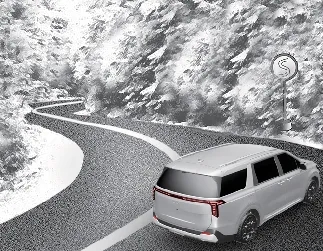
To maintain vehicle stability and passenger comfort, avoid braking or shifting gears while mid-corner, particularly
on wet or slippery road surfaces. Ideally, you should enter the corner at a safe speed and navigate it under gentle,
consistent acceleration. Adhering to these driving practices minimizes uneven tire wear and ensures your Kia
Carnival remains balanced through the turn.
Driving at night
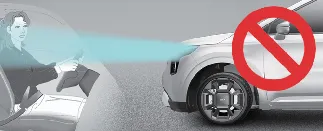
Night driving introduces unique challenges due to reduced visibility and the potential for fatigue. Follow these tips
to keep your Kia Carnival safe after dark:
- Reduce speed and increase distance: Visibility is significantly lower at night, especially on
unlit roads. Slow down and increase the following distance between you and the vehicle ahead to provide more time
to react to unexpected hazards.
- Manage mirror glare: Adjust your rearview mirrors to the "night" position to minimize the
blinding glare from the headlights of trailing vehicles.
- Maintain your lighting system: Keep your Kia Carnival headlights clean and
properly aligned. Dirty or misaligned lenses drastically reduce the effectiveness of your lights, making it
dangerous to navigate dark areas.
- Protect your night vision: Avoid looking directly at the headlights of oncoming traffic. Intense
light can temporarily blind you, and it may take several seconds for your eyes to readjust to the darkness,
leaving you vulnerable to road hazards during that recovery period.
Driving in the rain
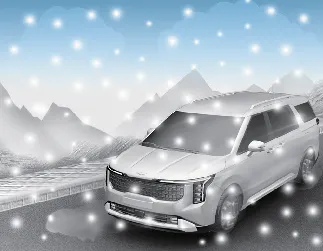
Navigating wet or rain-slicked roads requires increased focus and preparation. To maintain optimal control of your
Kia Carnival during inclement weather, please consider the following safety measures:
- Adjust your speed: Heavy rainfall significantly reduces visibility and increases the distance
required to bring your Kia Carnival to a complete stop. Always reduce your speed to match the
conditions.
- Maintain wiper equipment: Ensure your windshield wiper blades are in peak condition. Replace
them immediately if you notice streaking, chattering, or areas of the windshield that remain obscured.
- Monitor tire integrity: Worn-out tires drastically reduce traction on wet pavement, increasing
the risk of skidding. Periodically inspect your tires to ensure they have sufficient tread depth for safe
operation.
- Enhance visibility: Even during daylight hours, turn on your headlights when it rains. This
makes your Kia Carnival more visible to other motorists and improves your own field of view.
- Navigate puddles carefully: Driving at high speeds through deep water can cause hydroplaning or
splash water into the engine bay, potentially affecting brake performance. If you must pass through a puddle, do
so at a slow, controlled speed.
- Dry your brakes: If you suspect your brakes have become wet after driving through deep water,
apply the brake pedal lightly while moving at a safe, low speed until you feel the braking action return to its
normal, firm level.
Hydroplaning
Hydroplaning occurs when a layer of water builds up between your tires and the road surface, causing your Kia
Carnival to lose contact with the pavement. If you feel a loss of steering responsiveness or traction,
SLOW DOWN immediately. Maintaining healthy tire tread is your primary defense against hydroplaning; for specific
tread limits, please refer to the "More Details" section.
Driving in flooded areas
Exercise extreme caution when approaching flooded roads. Do not attempt to drive through water unless you are certain
it is no deeper than the bottom of the wheel hub. Proceed slowly and maintain a significant following distance, as
your Kia Carnival braking performance may be temporarily reduced. Once you have cleared the water,
always perform a safety check by gently applying the brakes multiple times to dry them out.
Highway driving
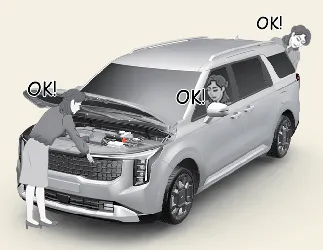
Tires
Before embarking on long highway trips, verify that your tire inflation pressures are set to the manufacturer's
specifications. Underinflation leads to excessive sidewall flexing and overheating, which can result in catastrophic
tire failure. Conversely, never exceed the maximum inflation pressure marked on the tire sidewall. Always replace
worn or damaged tires promptly to maintain the traction and reliability of your Kia Carnival.
 WARNING: Under/over inflated tires
Proper tire inflation is vital. Incorrect pressures in your Kia Carnival tires negatively impact
handling, increase the risk of sudden failure, and can lead to accidents or injury. Always verify pressures when
tires are cold, using the data found in the "More Details" section.
 WARNING: Tire tread
Inspect your tire tread depth before every journey. Worn-out tires lack the ability to channel water away, leading to
a loss of control. Replace tires that have reached their wear limits to ensure the continued safety of your
Kia Carnival. Consult "More Details" for specific tread depth requirements.
Fuel, engine coolant, and engine oil
Sustained high-speed driving places more demand on your engine and consumes fuel at a faster rate than urban driving.
Before long trips, verify that your engine coolant and oil levels are correct to prevent mechanical stress.
Drive belt
Periodically inspect the condition of your engine drive belt. A loose, frayed, or damaged belt can lead to poor
cooling and electrical charging issues, potentially causing the Kia Carnival engine to overheat.