Winter brings severe weather conditions that can lead to increased mechanical wear and unique operational challenges
for your Kia Carnival. Preparing your vehicle and adjusting your driving habits are essential for
maintaining safety and reliability during the colder months.
To minimize the challenges associated with winter driving, we recommend following these professional guidelines:
Snowy or icy conditions
When navigating deep snow, it may be necessary to equip your Kia Carnival with dedicated winter
(snow) tires or high-quality tire chains to maintain traction.
If you opt for snow tires, always select tires that are equivalent in size, type, and load rating to the original
factory equipment. Using incompatible tires can negatively impact the sophisticated handling and safety systems
integrated into your Kia Carnival. Furthermore, avoid aggressive maneuvers such as rapid
acceleration, sudden braking, or sharp, high-speed turns, as these are significantly more hazardous on slippery
surfaces.
When slowing down, utilize engine braking in combination with the service brakes. Sudden brake applications on icy or
snow-covered roads are the primary cause of uncontrolled skidding. Always maintain a generous following distance
between your Kia Carnival and the vehicle ahead. Apply the brake pedal with a gentle, gradual touch.
While tire chains significantly increase your driving force and grip in deep snow, they do not eliminate the risk of
side skidding; drive with extreme caution, and always verify that tire chains are permitted by your local state or
municipal laws before installation.
Snow tires
If you choose to install snow tires on your Kia Carnival, ensure that all four tires are radial
tires of the same size and load range as your original equipment. Installing snow tires on all four wheels is
critical to balancing the vehicle’s handling characteristics across various winter road conditions.
Please note that the traction provided by specialized snow tires on dry pavement may differ from your
factory-installed all-season tires. Consequently, continue to drive cautiously even when road conditions appear
clear. Always consult your tire dealer regarding the maximum speed ratings for your specific snow tires.
Additionally, do not install studded tires without first confirming that their use is permitted by your local, state,
and municipal regulations, as many areas have specific restrictions to prevent road surface damage.
 WARNING: Snow tire size
For your safety, snow tires must be equivalent in size and type to the original tires specified for your Kia
Carnival. Using incorrectly sized tires can compromise the vehicle’s electronic stability systems and
overall handling performance, potentially leading to a loss of control in hazardous winter conditions.
Tire chains
Wire-type chains
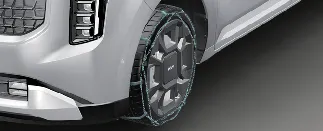
Fabric-type chains
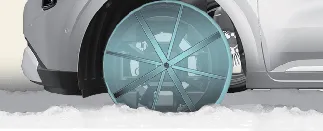
Due to the thinner sidewalls of modern radial tires, certain types of rigid snow chains may cause structural damage.
For optimal performance and safety, we generally recommend using specialized winter tires instead of chains.
Furthermore, do not attach metal tire chains to vehicles equipped with aluminum wheels, as the chains can easily
scratch or gouge the wheel finish. If the use of snow chains is mandatory, please follow these strict sizing and type
guidelines:
- For 19-inch tires, you must use fabric-type chains.
- For 17-inch tires, you may use wire-type chains, provided the thickness does not exceed 0.47 in
(12 mm).
Please be advised that any damage sustained by your Kia Carnival resulting from the improper
selection or installation of tire chains is not covered under the vehicle's warranty.
When installing tire chains on your Kia Carnival, observe the following procedures:
- Mounting Location: As the Kia Carnival is a front-wheel-drive vehicle, snow
chains must be mounted exclusively to the front tires to ensure proper traction and steering control.
- Monitor for Noise: After mounting, drive slowly. If you hear contact or clanking sounds, pull
over and adjust the chains immediately. Remove the chains as soon as you reach cleared road surfaces to prevent
damage to the tires and bodywork.
- Speed and Installation: Wrongly sized or loose chains can severely damage your vehicle's brake
lines, suspension components, and body panels. Follow the manufacturer’s instructions carefully and ensure the
chains are pulled as tight as possible. Always maintain a reduced speed of less than 20 mph (30 km/h) while chains
are installed.
 CAUTION
- Always verify that your snow chains are SAE class "S" certified and are the correct size for your specific tire.
Incorrect chains may strike vehicle components, leading to loose attachments or damage to the suspension.
- To ensure the chains remain secure, perform a safety check after driving for approximately 0.3 to 0.6 miles (0.5
to 1 km). Retighten them if they have loosened.
- Remember that fabric-type chains are mandatory for Kia Carnival models equipped with 19-inch
(235/55R19) tires.
Use high-quality ethylene glycol coolant
Your Kia Carnival is factory-delivered with high-quality ethylene glycol coolant, which is the only
recommended fluid for your cooling system. This specific coolant is formulated to prevent internal corrosion,
lubricate the water pump, and provide protection against freezing. Please ensure that you replace or replenish the
coolant strictly in accordance with the maintenance schedule found in your owner's manual.
As part of your winter preparation routine, have a professional test your coolant’s freezing point to ensure it
provides sufficient protection for the lowest anticipated temperatures in your region. This simple step helps
safeguard the engine block and radiator of your Kia Carnival against costly freeze-related damage.
Check battery and cables
Winter conditions place a significant strain on the electrical system of your Kia Carnival. Cold
temperatures reduce battery capacity while simultaneously requiring more power to crank the engine. Visually inspect
the battery terminals and cables for signs of corrosion or looseness as detailed in section 8 of your manual. We
highly recommend having the battery's state of charge and overall health tested by an authorized Kia dealer before
the onset of extreme cold.
Change to "winter weight" oil if necessary
In regions with harsh winters, switching to a lower-viscosity "winter weight" engine oil can significantly improve
cold-start performance by reducing internal friction. Please consult the "More Details" section of your owner's
manual for specific viscosity recommendations. If you remain uncertain about the appropriate oil for your Kia
Carnival, consult an authorized Kia dealer for expert guidance.
Check spark plugs and ignition system
A reliable ignition system is vital for starting your Kia Carnival in freezing temperatures. Inspect
your spark plugs according to the schedule in "More Details" and replace them if they show signs of wear.
Additionally, verify that all ignition wiring and components are free from cracks, fraying, or any physical damage
that could cause misfires during cold starts.
To keep locks from freezing
To prevent door locks from freezing, apply an approved de-icer fluid or a small amount of glycerine into the keyhole.
If a lock is already iced over, use an approved de-icing spray to clear the surface. For internally frozen locks, you
may attempt to thaw the mechanism using a carefully heated key; please handle the key with extreme caution to avoid
thermal burns.
Use approved window washer anti-freeze in system
Ensure your Kia Carnival maintains clear visibility by adding an approved window washer anti-freeze
solution to the reservoir. Follow the dilution instructions on the container to prevent the fluid from freezing on
your windshield. These solutions are available at authorized Kia dealers and most automotive supply stores.
Important: Never use engine coolant or standard radiator anti-freeze in the washer system, as these
chemicals can severely damage the vehicle's paint finish.
Don't let your parking brake freeze
In conditions with heavy snow or high humidity followed by a deep freeze, the parking brake on your Kia
Carnival can freeze in the engaged position. If you anticipate such conditions, park on level ground,
shift to P (Park), and use wheel chocks to secure the vehicle. Engage the parking brake only temporarily to secure
the car while you place the chocks, then release it to prevent it from seizing.
Don't let ice and snow accumulate underneath
Snow and ice buildup under the fenders can physically obstruct the steering linkage and front wheel movement. When
driving your Kia Carnival in severe winter conditions, periodically inspect the wheel wells and
undercarriage to ensure that no packed ice is interfering with steering components or drivetrain movement.
Carry emergency equipment
Preparation is key to winter safety. Depending on your local climate, we recommend keeping an emergency kit in your
Kia Carnival. Essential items include: tire chains, tow straps, a high-lumen flashlight, emergency
flares, a small bag of sand for traction, a sturdy shovel, high-quality jumper cables, a heavy-duty window scraper,
insulated gloves, a ground cloth, warm coveralls, and a thermal blanket.
Do not place objects or materials in the engine compartment
Keep the engine bay of your Kia Carnival free of any foreign objects, debris, or materials. Items
placed in the engine compartment can obstruct critical airflow, leading to engine overheating, mechanical failure, or
even a risk of combustion. Please note that any damage resulting from such obstructions is not covered by your
Kia Carnival vehicle warranty.
Water vapor in the exhaust system
If your Kia Carnival is left idling for an extended period in cold winter weather, you may notice
water vapor condensing and accumulating inside the exhaust pipes. This is a natural byproduct of combustion. While
this water may cause temporary exhaust noise, it is automatically drained when you drive the vehicle at medium to
high speeds, allowing the exhaust system to reach its optimal operating temperature.