If you intend to use your Kia Carnival for towing, first confirm the legal requirements with your
local Department of Motor Vehicles or equivalent transportation authority. Regulations regarding towing capacity,
trailer brakes, and lighting can vary significantly by region. For specific advice regarding your towing setup,
please consult an authorized Kia dealer.
 WARNING: Towing a trailer
Towing requires correct equipment and professional driving techniques. If your trailer is improperly balanced or
exceeds the weight limits, you may lose control of your Kia Carnival. Additionally, if the trailer
is too heavy, the vehicle's braking system may be overwhelmed, increasing the risk of serious or fatal injury. Only
attempt to pull a trailer after thoroughly reading and following all safety procedures outlined in this section.
 WARNING: Weight limits
Before connecting your trailer, ensure that the total trailer weight, gross combination weight (GCW), gross vehicle
weight (GVW), gross axle weight, and trailer tongue load are all within the prescribed safety limits for your
Kia Carnival.
 NOTICE
- The technically permissible maximum load on the rear axle may be exceeded by no more than 15%, and the maximum
laden mass of the vehicle by no more than 10% or 220.4 lbs (100 kg), whichever is lower. Under these specific
conditions, you must not exceed 60 mph (100 km/h) for category M1 vehicles or 50 mph (80 km/h) for category N1
vehicles.
- The additional load on the coupling device may cause rear tire ratings to be exceeded by up to 15%. In this
scenario, do not exceed 60 mph (100 km/h), and ensure your rear tire pressure is increased by at least 0.2 bar (20
kPa) above the standard recommended pressure for daily use.
 CAUTION
Improper towing can cause premature wear or catastrophic failure of drivetrain components, leading to expensive
repairs not covered by your warranty. To ensure a safe experience, identify your Kia Carnival
trailering capacity using the specifications in the "More Details" section.
Remember that towing fundamentally changes the handling, acceleration, braking, and fuel economy of your Kia
Carnival. Components such as the engine, transmission, wheel assemblies, and tires are subjected to
significantly higher stress and heat. Furthermore, the trailer increases wind resistance, further increasing the load
on the vehicle. Successful, safe towing requires utilizing only high-quality, correctly matched equipment.
 NOTICE: Location of trailer mounting
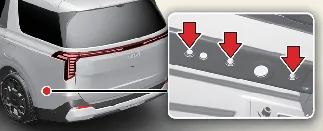
The designated mounting points for trailer hitches are located on both sides of the underbody, situated behind the
rear tires of your Kia Carnival. Ensure that any aftermarket or OEM hitch is bolted securely to
these specific locations according to the manufacturer's installation guidelines.
Hitches
Selecting the correct hitch equipment is vital for maintaining stability and control of your Kia
Carnival when towing. Factors such as crosswinds, passing heavy trucks, and uneven road surfaces can
induce sway, making a high-quality, properly installed hitch essential. Please adhere to these professional safety
guidelines:
-
Sealing the vehicle body: If your hitch installation requires drilling holes into the bodywork
of your Kia Carnival, you must ensure these openings are professionally sealed immediately
upon installation or when the hitch is removed. Failure to properly seal these points can allow deadly carbon
monoxide (CO) from the exhaust, as well as road dirt and water, to enter the cabin.
-
Avoid bumper-mounted hitches: The bumpers on your Kia Carnival are not
engineered to support the loads associated with towing. Never utilize rental hitches or bumper-clamp systems.
You must use only an appropriate frame-mounted hitch that is explicitly designed for the vehicle's chassis
structure.
-
Visibility and compliance: Your license plate and rear lighting must remain fully visible at
all times. If a mechanical coupling device (hitch) obstructs these, it must be removed or repositioned when not
in active use. Devices that are difficult to remove without tools are generally not permitted unless they
comply with specific local regulations regarding visibility. Always ensure your hitch setup complies with
regional transport authority rules.
-
Genuine accessories: For the best fit and compatibility, we strongly recommend purchasing a
genuine Kia trailer hitch accessory through your authorized Kia dealer.
Safety chains
Safety chains are a critical secondary safety measure. You must always attach chains between your Kia
Carnival and the trailer. It is recommended to cross the safety chains under the trailer tongue; this
ensures that if the trailer separates from the hitch while in motion, the tongue will be cradled by the chains rather
than dropping directly onto the road surface.
Always follow the specific attachment instructions provided by the hitch or trailer manufacturer. Ensure you leave
just enough slack in the chains to allow for comfortable turning of the Kia Carnival and trailer,
but never allow the chains to drag on the ground, as this can cause them to wear down or snag on road debris.
Trailer brakes
If your trailer is equipped with a braking system, it must conform to all national and local regulations, and it must
be installed and maintained in perfect working order. If your trailer's loaded weight exceeds the maximum rating for
a trailer without brakes, it is legally and mechanically required to have its own independent braking system.
Always read and adhere to the manufacturer's documentation regarding the installation, adjustment, and long-term
maintenance of your trailer brakes.
 WARNING: Trailer brakes
Do not attempt to operate a trailer with its own braking system unless you are certain the integration is flawlessly
executed. This is a complex mechanical task that should not be handled by amateurs. To ensure the safety of yourself
and your passengers, always utilize an experienced, competent trailer service shop to configure and test your
Kia Carnival towing setup.
Maintenance when trailer towing
Regular towing places additional stress on your vehicle's mechanical components. Consequently, your Kia Carnival will
require more frequent servicing. Key areas of focus include engine oil, transmission fluid, axle lubricant, and the
cooling system. Monitoring brake pad wear is also critical, as the added weight of a trailer increases the workload
on your braking system significantly.
Do not neglect your trailer and hitch assembly. Follow the maintenance schedule provided by the trailer manufacturer
and perform a quick visual inspection at the start of every driving day. Ensure all hitch hardware, nuts, and bolts
are tightened to the manufacturer's specifications.
 CAUTION
-
Towing increases the likelihood of engine overheating, particularly on hot days or during steep climbs. If the
coolant temperature gauge begins to rise toward the "H" zone, immediately switch off the air conditioning and
pull over to a safe area. Allow the engine to idle until the temperature normalizes.
-
When towing a trailer, check the transmission fluid levels and condition more frequently than the standard
schedule suggests to prevent fluid degradation.
-
If your vehicle is not equipped with an air conditioner, we strongly recommend installing an auxiliary
condenser fan. This improves airflow through the radiator, significantly enhancing engine cooling performance
when you are towing with your Kia Carnival.