If you are planning to utilize your Kia Carnival for towing, it is essential to prioritize safety and vehicle
longevity. Please review the following professional guidelines:
-
Sway control: For enhanced stability, consider installing a sway control device. You can
consult with a specialized hitch dealer to select the most appropriate system for your Kia Carnival
configuration.
-
Engine break-in period: Do not use your vehicle for any towing activities during the first
1,200 miles (2,000 km). Allowing the engine and transmission to properly break in is critical. Failing to
adhere to this requirement can result in severe and permanent mechanical damage.
-
Professional consultation: Before attempting to tow, visit an authorized Kia dealer. They can
verify if your specific vehicle requires additional equipment, such as a specialized towing kit, heavy-duty
cooling components, or upgraded suspension elements.
-
Speed management: Always maintain a moderate driving speed. When towing, do not exceed 60 mph
(100 km/h) under normal road conditions.
-
Uphill gradients: When navigating long or steep uphill grades, keep your speed below 45 mph
(70 km/h) or the posted towing speed limit, whichever is lower, to prevent drivetrain stress.
-
Weight considerations: Always refer to the technical specifications in the "More Details"
section of this manual. Understanding the relationship between gross vehicle weight and towing capacity is
vital for safe operation.
Weight of the trailer

A: Tongue Load | B: Total Trailer Weight
Determining the maximum safe weight for your trailer is a complex calculation. It must never exceed the
manufacturer’s specified maximum trailer weight with brakes. Remember that the "maximum" rating is a structural
limit, not a recommendation for daily use.
The actual safe towing capacity depends on various environmental and operational factors, including your driving
speed, altitude, road gradients, ambient temperature, and the frequency of your towing operations. Furthermore, the
presence of specific performance equipment on your Kia Carnival can influence these limits.
Weight of the trailer tongue
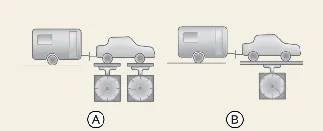
A: Gross Axle Weight | B: Gross Vehicle Weight
Measuring the trailer tongue load is critical, as it directly impacts the Gross Vehicle Weight (GVW) of your Kia
Carnival. Your total GVW is the sum of the vehicle's curb weight, all passengers, cargo, and the trailer tongue load.
When you add a trailer, that tongue load effectively becomes part of the weight your vehicle must carry.
As a rule of thumb, the trailer tongue should weigh a maximum of 10% of the total loaded trailer weight, provided
this does not exceed the maximum permissible tongue load for the vehicle. After loading your trailer, it is highly
recommended to weigh the trailer and the tongue separately at a certified scale to ensure the distribution is
balanced. If adjustments are required, simply redistribute your cargo within the trailer to achieve the correct
balance.
 WARNING
Trailer loading safety:
-
Never load more weight in the rear of the trailer than in the front. To ensure stability and prevent swaying,
load approximately 60% of the total trailer weight in the front section (near the tongue) and 40% in the rear.
-
Never exceed the maximum weight limits specified for the trailer or your Kia Carnival towing equipment.
Improper loading can cause catastrophic structural failure and personal injury. Always verify your setup using
professional scales at a commercial site or a highway patrol inspection facility.
-
An improperly loaded or unbalanced trailer is a significant hazard that can cause a loss of control,
potentially resulting in a serious accident, severe injury, or death.