Understanding your vehicle's load capacity is fundamental to ensuring safe operation and longevity. The official
vehicle load limit for your Kia Carnival is clearly displayed on the "Tire and Loading Information" label, which is
conveniently located on the driver's door pillar.
Tire and loading information label
This label provides critical data specific to your Kia Carnival, including the original tire size, the recommended
cold tire pressures, the maximum number of passengers, and the total vehicle capacity weight. Always refer to this
label when checking for proper tire inflation or before loading the vehicle for a trip.
Example for spare tire
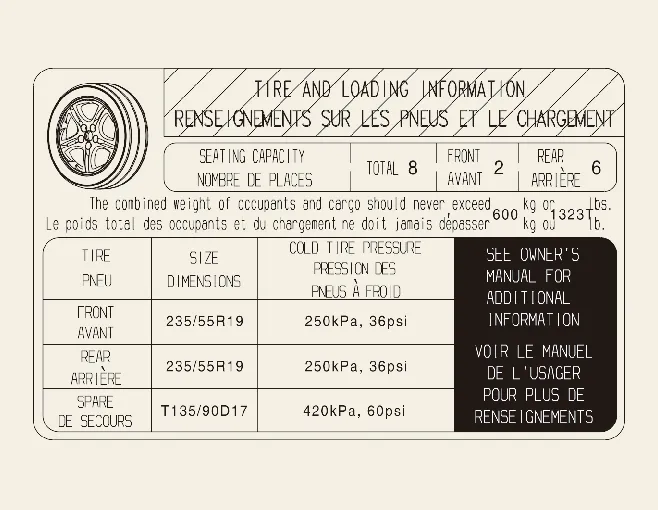
Vehicle capacity weight:
- 7-seat configuration: 1,157 lbs. (525 kg)
- 8-seat configuration: 1,323 lbs. (600 kg)
The "Vehicle Capacity Weight" represents the maximum combined weight of all occupants and cargo. If you are towing,
please remember that this total must also include the trailer's tongue load, as this weight presses directly onto the
Kia Carnival chassis.
Seating capacity:
Total: 7/8 persons (Front row: 2 persons, Rear rows: 5/6 persons).
Seating capacity defines the maximum number of occupants the vehicle is designed to carry. Please note that this
capacity may need to be reduced if you are carrying heavy cargo or towing a trailer, as the total weight of all
occupants and cargo combined must never exceed the specified load limit. Overloading the Kia Carnival can lead to
poor handling, increased tire wear, and diminished braking performance.
Towing capacity:
- Smartstream G3.5 GDi engine:
- Without trailer brakes: 1,001 lbs. (454 kg)
- With trailer brakes: 3,501 lbs. (1,588 kg)
Towing capacity is the absolute maximum weight of the trailer, including its cargo, that your Kia Carnival is rated
to tow safely. Exceeding these limits is strictly discouraged.
Cargo capacity:
Your Kia Carnival cargo capacity is dynamic; it increases or decreases depending on the total weight and the number
of passengers currently on board. Always calculate your passenger weight first to determine the remaining allowance
for cargo or additional gear.
Steps For Determining Correct Load Limit
To ensure safe handling and optimal performance of your Kia Carnival, it is vital to calculate your vehicle's payload
capacity accurately. Follow these steps to determine the correct load limit:
-
Locate the "Tire and Loading Information" placard on the driver’s side door pillar. Find the statement: "The
combined weight of occupants and cargo should never exceed XXX kg or XXX lbs."
-
Calculate the combined weight of the driver and all intended passengers who will be traveling in your Kia
Carnival.
-
Subtract this total passenger weight from the maximum vehicle capacity weight (the "XXX" value found in Step
1).
-
The resulting figure represents your available cargo and luggage capacity. For example, if your Kia Carnival
has a capacity of 1,400 lbs. and you are carrying five passengers weighing 150 lbs. each (total 750 lbs.), your
remaining cargo allowance is 650 lbs. (1,400 lbs. - 750 lbs. = 650 lbs.).
-
Determine the total weight of all luggage and cargo to be loaded. Ensure this weight does not exceed the
available cargo capacity calculated in the previous step.
-
If you are towing a trailer, remember that a portion of the trailer's weight (tongue load) is transferred to
your vehicle. Consult the towing section of this manual to understand how this reduces your remaining cargo
capacity.
 WARNING
Loose cargo: Never travel with unsecured or blunt objects within the passenger compartment of your
Kia Carnival (e.g., loose suitcases or unsecured child seats). In the event of a sudden stop or collision, these
items can become projectiles, striking occupants and causing serious injury.
Example 1: Light passenger load

|
Item
|
Description
|
Total
|
|
A
|
Vehicle Capacity Weight
|
849 lbs. (385 kg)
|
|
B
|
Subtract Occupant Weight (150 lbs. x 2)
|
300 lbs. (136 kg)
|
|
C
|
Available Cargo and Luggage weight
|
549 lbs. (249 kg)
|
Example 2: Standard passenger load

|
Item
|
Description
|
Total
|
|
A
|
Vehicle Capacity Weight
|
849 lbs. (385 kg)
|
|
B
|
Subtract Occupant Weight (150 lbs. x 5)
|
750 lbs. (340 kg)
|
|
C
|
Available Cargo and Luggage weight
|
99 lbs. (45 kg)
|
Example 3: Heavy passenger load

|
Item
|
Description
|
Total
|
|
A
|
Vehicle Capacity Weight
|
849 lbs. (385 kg)
|
|
B
|
Subtract Occupant Weight (161 lbs. x 5)
|
805 lbs. (365 kg)
|
|
C
|
Available Cargo and Luggage weight
|
44 lbs. (20 kg)
|
Always refer to the tire and loading information label on your specific Kia Carnival for accurate data regarding
capacity weight and seating positions. The combined weight of the driver, passengers, and all cargo should never
exceed the vehicle's rated capacity to ensure your safety on the road.
Certification label
The official certification label for your Kia Carnival is located on the driver's door sill, specifically on the
center pillar. This label serves as the definitive reference for your vehicle's structural load limits.

This label specifies the Gross Vehicle Weight Rating (GVWR), which represents the maximum allowable weight of your
Kia Carnival when fully loaded. The GVWR is the total sum of the vehicle’s curb weight, all passengers, and any cargo
currently on board.
Additionally, the label provides the Gross Axle Weight Rating (GAWR) for both the front and rear axles, indicating
the maximum weight each axle is engineered to support. To determine the actual current load on your front and rear
axles, you should visit a certified weigh station. Your local Kia dealer can provide guidance on where to find these
facilities. When loading, always ensure that your cargo is distributed evenly across the vehicle's centerline to
maintain balance and handling stability.
 WARNING: Overloading
Never exceed the GVWR for your Kia Carnival, the GAWR for either the front or rear axle, or the total vehicle
capacity weight. Exceeding these engineering ratings can severely compromise your vehicle's steering, handling, and
braking performance.
The certification label acts as a vital tool for determining how much cargo and aftermarket equipment your vehicle
can safely carry. Please remember that all loose items—such as suitcases, tools, or packages—must be properly
secured. In the event of a sudden stop or a collision, any unsecured object will maintain its momentum and can strike
occupants with significant force, leading to serious injury.
 WARNING: Overloading
Do not overload your Kia Carnival. Exceeding load limits causes excessive heat buildup in the tires, which
significantly increases the risk of sudden tire failure. Furthermore, overloading increases stopping distances and
degrades vehicle stability, all of which substantially heighten the probability of a crash.
 NOTICE
Consistently overloading your vehicle may cause mechanical damage to suspension and drivetrain components. Please be
aware that any repairs necessitated by overloading are not covered under the terms of your Kia Carnival warranty.