For your safety, long-term vehicle maintenance, and optimal fuel economy, it is imperative that you maintain the
manufacturer-recommended tire inflation pressures at all times. Always ensure that your Kia Carnival remains within
the specified vehicle load limits and follows the recommended weight distribution guidelines.
Recommended cold tire inflation pressures
Always verify tire pressure when the tires are "cold." A "cold tire" is defined as one that has not been driven for
at least three hours or has been driven for less than 1 mile (1.6 km). Checking pressure while the tires are warm
will result in inaccurate readings, as internal air pressure rises during normal driving.
Maintaining the recommended inflation pressures is essential for ensuring a comfortable ride, superior vehicle
handling, and uniform tire wear throughout the life of the tires on your Kia Carnival.
The official inflation pressure specifications, along with the correct tire sizes, can be found on the manufacturer’s
label permanently attached to the driver's side center door pillar.

 WARNING: Tire underinflation
Always inflate your tires in strict accordance with the specifications provided in this manual and on the door pillar
placard. You should regularly check and adjust your Kia Carnival tire pressure at least twice a month and always
before embarking on long-distance trips. Operating your vehicle with underinflated tires can significantly compromise
driving stability. Furthermore, underinflation can cause severe internal tire damage and significantly increase the
risk of a blowout, which may lead to an accident resulting in serious injury or death. This risk is notably elevated
during hot weather conditions and when operating the Kia Carnival at high speeds for extended durations.
Neglecting to maintain the correct tire pressure may result in rapid and uneven tread wear, sluggish handling,
reduced fuel efficiency, structural deformation of the tire or wheel, a harsh ride quality, and a heightened
vulnerability to damage from road hazards, potentially leading to total tire failure.
Tire pressure
To ensure optimal performance and safety for your Kia Carnival, always observe the following maintenance practices:
-
Always verify tire pressure when the tires are cold. A "cold" tire is one that has been parked for at least
three hours or driven for less than 1 mile (1.6 km) since the vehicle was started.
-
If your Kia Carnival is equipped with a spare tire, check its pressure regularly every time you check the
primary tires to ensure it is ready for emergency use.
-
Never exceed the vehicle's maximum load capacity. If your Kia Carnival is fitted with a roof luggage rack,
exercise extreme caution not to overload it, as this can negatively affect vehicle stability and tire stress.
-
Be aware that warm tires will naturally show an increase in pressure of 4 ~ 6 psi (28 ~ 41 kPa) above the
recommended cold specifications. Do not bleed air from warm tires to "adjust" them, as this will lead to
underinflation once the tires cool down.
 WARNING: Tire Inflation
Both overinflation and underinflation can significantly reduce the service life of your tires, negatively impact the
handling characteristics of your Kia Carnival, and ultimately lead to sudden, catastrophic tire failure. Such
failures can cause a total loss of vehicle control, resulting in serious injury or death.
Checking tire inflation pressure
For your safety, you should inspect your tires at least once a month or more frequently if you drive long distances.
Always use a high-quality, calibrated tire pressure gauge. You cannot accurately judge if a tire is properly inflated
simply by a visual inspection. Modern radial tires, like those on your Kia Carnival, may appear correctly inflated
even when they are critically underinflated.
Remember: Always check pressure when the tires are cold (the vehicle has been stationary for at least three hours or
driven no more than 1 mile).
-
Remove the protective valve cap from the tire valve stem.
-
Press the tire gauge firmly onto the valve stem to obtain an accurate measurement. If the current pressure
matches the value listed on the Kia Carnival tire and loading information label, no further action is required.
-
If the pressure reading is below the recommended level, carefully add compressed air until you reach the target
specification.
-
If you accidentally overfill the tire, release the excess air by gently pressing the metal pin located in the
center of the valve stem.
-
Recheck the pressure with your gauge to confirm it is within the recommended range for your Kia Carnival.
-
Always reinstall the valve caps securely. These caps are vital for preventing slow leaks by keeping dirt,
debris, and moisture away from the valve mechanism.
Make it a habit to frequently inspect your tires for proper inflation, as well as signs of irregular wear, cuts, or
bulges. Always rely on a dedicated tire pressure gauge rather than your eyes.
Operating your Kia Carnival with improper tire pressure leads to uneven tread wear. This not only diminishes fuel
economy but can also result in poor vehicle handling, loss of control, and sudden tire failure—dangers that can lead
to accidents, injuries, or fatalities. The recommended cold tire pressure for your Kia Carnival is clearly stated in
this owner's manual and on the tire information label attached to the driver's side center pillar.
Tire rotation
To ensure even tread wear and maximize the lifespan of your tires, we recommend rotating them on your Kia Carnival
every 8,000 miles (13,000 km). If you notice signs of irregular or premature wear, rotate the tires sooner.
During every rotation service, it is also essential to have your tires checked for correct wheel balance to ensure a
smooth ride.
While performing the rotation, thoroughly inspect each tire for signs of uneven wear, cuts, or physical damage.
Abnormal wear is typically caused by incorrect tire inflation pressure, improper wheel alignment, out-of-balance
wheels, or aggressive driving habits like severe braking and cornering. Inspect the tread and sidewalls for any
bumps, bulges, or embedded objects; if found, the tire must be replaced immediately. If fabric or steel cords become
visible at any point, the tire is no longer safe to use. After completing the rotation, ensure front and rear tire
pressures are adjusted to factory specifications and verify that all lug nuts are tightened to the correct torque
(typically 79 ~ 94 lbf·ft [11 ~ 13 kgf·m]).
For more detailed information regarding specific rotation patterns, refer to the "More Details" section of this
manual.
Additionally, take this opportunity to have the disc brake pads of your Kia Carnival inspected for thickness and wear
whenever the tires are rotated.
With a full-size spare tire (if equipped)

Without a spare tire

Directional tires (if equipped)

If your Kia Carnival is fitted with directional tires or radial tires featuring an asymmetric tread pattern, you
should only rotate them from the front axle to the rear axle on the same side, and never from right to left.
 WARNING: Mixing tires
Never, under any circumstances, mix bias-ply and radial-ply tires on your Kia Carnival. This configuration creates
unpredictable handling characteristics that can lead to a sudden loss of vehicle control, significantly increasing
the risk of an accident, serious injury, or death.
Wheel alignment and tire balance
The wheels on your Kia Carnival were precisely aligned and balanced at the factory to deliver the longest possible
tire life and the highest level of driving performance. If you notice irregular tire wear or if your vehicle
consistently pulls to one side, the wheel alignment may require adjustment.
Furthermore, if you experience vibration or steering wheel shudder while driving on smooth road surfaces, your wheels
likely need to be rebalanced by a professional technician.
 CAUTION: Wheel weight
Using incorrect or low-quality wheel weights can cause permanent damage to your Kia Carnival's aluminum alloy wheels.
Always insist on using approved, corrosion-resistant wheel weights.
Tire replacement
When a tire reaches its wear limit, a "tread wear indicator" will appear as a continuous solid band across the
surface of the tread.
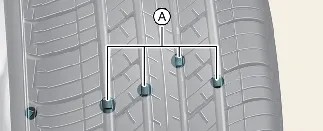
[A]: Tread wear indicator
The appearance of this band signifies that there is less than 1/16 in (1.6 mm) of remaining tread depth; you must
replace the tire at this point. Do not wait until this indicator band is visible across the entire tread surface
before seeking replacement.
Because the Anti-lock Braking System (ABS) and Electronic Stability Control (ESC) function by monitoring individual
wheel speeds, tire size plays a critical role. When replacing tires on your Kia Carnival, you must use the same size
and type as originally supplied. Installing tires of a different size can cause the ABS and ESC systems to
malfunction, compromising your safety.
It is always ideal to replace all four tires simultaneously. If this is not feasible, at minimum, you must replace
the two front or two rear tires as a set to maintain axle parity. Replacing a single tire on a Kia Carnival can
drastically impair the vehicle's handling and braking performance.
 NOTICE
When replacing tires, always ensure you use tires that match the specifications originally supplied with the Kia
Carnival to maintain peak driving performance and safety.
Wheel replacement
When the time comes to replace the wheels on your Kia Carnival, it is critical to ensure that any new wheels—whether
alloy or steel—are identical to the original factory specifications. This includes matching the diameter, rim width,
and offset (inset) perfectly.
Installing wheels with incorrect dimensions can have a detrimental effect on several vehicle systems: it may
significantly reduce the service life of wheel bearings and hubs, impair your Kia Carnival braking performance, alter
handling characteristics, change ground clearance, cause unwanted contact between tires and body panels, interfere
with snow chain clearance, cause inaccuracies in speedometer and odometer readings, misalign your headlamp
projection, and affect the standard bumper height.
 CAUTION: Wheels
Wheels that do not meet strict Kia engineering specifications may not seat properly, leading to potential mechanical
damage, unpredictable handling, and poor vehicle control. Such failures significantly increase the risk of accidents,
which could result in serious injury or death.
Tire traction
The level of grip—or traction—provided by your Kia Carnival tires can be severely compromised by driving on worn-out
treads, using improperly inflated tires, or encountering slippery road surfaces such as rain, snow, or ice.
Tires must be replaced immediately when the tread wear indicators become visible. Always reduce your driving speed
whenever environmental conditions like heavy rain, slush, snow, or black ice are present on the road to minimize the
risk of hydroplaning or losing control of your Kia Carnival.
Tire maintenance
In addition to maintaining the correct inflation pressure as outlined in your manual, precise wheel alignment is
essential for reducing premature or irregular tire wear.
If you observe that your Kia Carnival tires are wearing unevenly across the tread, have your authorized Kia dealer
inspect and correct the wheel alignment immediately.
Furthermore, ensure that all newly installed tires are balanced correctly by a professional. Proper balancing not
only increases your Kia Carnival ride comfort but also significantly extends the life of the tires. Always rebalance
a tire whenever it has been removed from the wheel for service or replacement.
All season tires
To provide reliable, year-round performance across a diverse range of driving conditions—including occasional light
snow and icy surfaces—Kia equips certain Kia Carnival models with all-season tires as standard.
You can easily identify these versatile tires by the "ALL SEASON" designation and/or the "M+S" (Mud and Snow) symbol
imprinted on the tire sidewall. While these tires offer a convenient balance for varying climates, dedicated winter
or snow tires provide superior traction in deep snow and extreme cold, and may be a more appropriate choice for
drivers residing in regions with severe winter weather.
Summer tires
For enhanced handling, responsiveness, and grip on dry, warm road surfaces, some Kia Carnival models are
factory-equipped with high-performance summer tires.
It is important to understand that summer tire performance is substantially compromised when driving on snow, slush,
or ice. Because summer tires do not feature the "M+S" (Mud and Snow) traction rating on the sidewall, they are not
suitable for winter use. If you intend to operate your Kia Carnival in snowy or sub-freezing conditions, Kia strongly
recommends installing a full set of dedicated snow tires or high-quality all-season tires on all four wheels to
ensure safety and vehicle control.
Snow tires
If you choose to equip your Kia Carnival with dedicated winter or snow tires, ensure they match the original factory
tire size and load capacity specifications to maintain proper vehicle dynamics.
For consistent handling and braking, always install snow tires on all four wheel positions. Installing them on only
one axle can lead to unpredictable handling characteristics and potential loss of control.
To account for the colder temperatures and winter conditions, snow tires should generally be inflated to 4 psi (28
kPa) above the standard pressure recommended on the tire placard located on the driver’s side center pillar. Do not
exceed the maximum inflation pressure marked on the tire sidewall. Additionally, avoid driving at speeds exceeding 75
mph (120 km/h) when your vehicle is fitted with snow tires.
 WARNING
Never operate your Kia Carnival using summer tires at temperatures below 45 °F (7 °C), or on road surfaces covered in
snow or ice. At these lower temperatures, the rubber compounds in summer tires lose their elasticity, resulting in a
dramatic reduction in both traction and braking effectiveness. In cold climates, always switch to certified winter or
all-weather tires—identified by the M+S (Mud and Snow) marking—that match the standard sizing of your Kia Carnival.
Continuing to use summer tires in freezing conditions can cause the tread to harden, lead to structural cracks, and
permanently damage the tires.
Tire chains
If extreme winter conditions necessitate the use of tire chains, they must be installed specifically on the front
wheels of your Kia Carnival. Always ensure that the chains are fitted strictly in accordance with the manufacturer's
provided instructions.
To prevent unnecessary wear to your tires and the chains themselves, remove the chains immediately once you reach
cleared roads.
-
When driving on snow- or ice-covered roads with chains installed, keep your speed below 20 mph (30 km/h).
-
Always utilize SAE "S" class or approved wire-link type chains.
-
If you hear noise suggesting the chains are contacting the vehicle body or wheel wells, stop safely and
retighten the chains to ensure proper clearance.
-
To prevent potential body damage, always check and retighten your chains after driving the first 0.3 ~ 0.6
miles (0.5 ~ 1.0 km) following installation.
-
Avoid using traditional tire chains on Kia Carnival vehicles equipped with aluminum wheels, as they can cause
significant surface damage. If their use is absolutely unavoidable, opt for a wire-type chain.
-
When using wire chains, ensure the thickness is less than 0.47 inches (12 mm) to prevent damage to the chain
connection points and vehicle components.
Radial-ply tires
Radial-ply tires are the industry standard for modern vehicles, engineered to provide superior tread life, enhanced
resistance to road hazards, and a significantly smoother ride quality, especially at higher highway speeds.
The radial-ply tires factory-fitted to your Kia Carnival utilize a sophisticated belted construction. These specific
tires have been meticulously selected by Kia engineers to perfectly complement the suspension geometry, ride comfort,
and dynamic handling characteristics of your Kia Carnival. While they offer distinct performance advantages,
radial-ply tires maintain the same load-carrying capacity and utilize the identical recommended cold inflation
pressures as bias-ply or bias-belted tires of equivalent dimensions.
Crucial Safety Warning: Never mix radial-ply tires with bias-ply or bias-belted tires on your Kia
Carnival. Installing a combination of different tire construction types on the same vehicle will severely degrade
stability and handling, leading to unpredictable and dangerous driving dynamics. For optimal safety and performance,
the golden rule is to ensure that all four wheels on your Kia Carnival are fitted with identical, matching radial-ply
tires.
While modern radial-ply tires are designed for longevity, their construction can sometimes make them more susceptible
to irregular wear patterns if not maintained correctly. To maximize tread life and ensure uniform wear, it is
essential to strictly adhere to the tire rotation intervals outlined in this manual. Furthermore, due to the unique
way radial sidewalls flex during operation, please note that any cuts or punctures in radial-ply tires are generally
only repairable if they are located within the tread area. If you sustain damage to the sidewall or shoulder, the
structural integrity may be compromised; always consult with a professional tire dealer to assess whether a safe
repair is possible for your Kia Carnival tires.