When choosing a Child Restraint System for your Kia Carnival, always prioritize safety by observing the following
guidelines:
Never hold a child in your arms or on your lap while the Kia Carnival is in motion. The violent forces generated
during a crash can easily tear the child from your grasp, causing them to strike the vehicle’s interior with
dangerous intensity. Always secure your child in an appropriate, properly installed CRS.
Never leave children unattended inside your Kia Carnival. Even in moderate weather, a vehicle's interior can heat up
to life-threatening temperatures within minutes, posing a severe risk of injury or death to an unattended child.
Never allow two occupants to share a single seat belt. Doing so nullifies the safety benefits intended by the
restraint system and significantly increases the risk of serious injury to both individuals in the event of an
accident.
Child Restraint Systems (CRS) are essential for passenger safety in your Kia Carnival. There are three primary
categories—rear-facing seats, forward-facing seats, and booster seats—which are specifically classified based on your
child's developmental stage, including age, height, and weight.
Rear-facing child seats
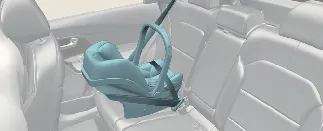
A rear-facing child seat is engineered to support the child’s entire body, with the seat back absorbing the forces of
an impact. The integrated harness system secures the child in place; in the event of an accident, this configuration
effectively distributes crash forces across the seat shell, significantly reducing stress on the child's developing
neck and spinal cord.
Safety experts and regulations mandate that all children under the age of one must travel in a rear-facing infant
restraint. Many modern convertible and 3-in-1 child seats offer expanded height and weight thresholds for the
rear-facing position, which allows you to keep your child in this highly protective orientation for as long as
possible.
We recommend continuing the use of a rear-facing seat in your Kia Carnival until your child reaches the maximum
height or weight limits specified by the seat manufacturer. This provides the highest level of safety. Once your
child exceeds these limits, they are ready to transition to a forward-facing child restraint equipped with a harness.
Forward-facing child restraints
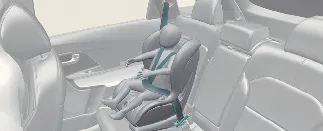
A forward-facing child seat uses a dedicated harness system to provide restraint for the child's torso and body. It
is vital to keep your child in a forward-facing seat with a harness until they reach the maximum height or weight
capacity established by the manufacturer. Maintaining the harness system for as long as permissible is crucial for
the safety of children traveling in the Kia Carnival.
Once your child has outgrown the physical limits of the forward-facing restraint, they are ready to transition to a
booster seat.
Booster seats
A booster seat is a specialized restraint designed to elevate the child, ensuring the Kia Carnival's standard 3-point
seat belt system fits correctly over their body. By properly positioning the child, the booster seat ensures the seat
belt follows the contours of the skeletal structure rather than soft tissue.
You should continue to use a booster seat until your child is large enough to sit correctly using only the vehicle's
seat belt. A seat belt is considered to fit properly when the lap portion lies snugly across the upper thighs, rather
than the stomach, and the shoulder belt rests comfortably across the center of the chest and shoulder, avoiding
contact with the neck or face. Please remember that for maximum safety, all children under the age of 13 must always
ride in the rear seats of the Kia Carnival and be properly restrained at all times to minimize the risk of injury
during sudden stops or collisions.
 WARNING: Holding children
 WARNING: Unattended children
 WARNING: Seat belt use