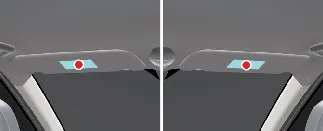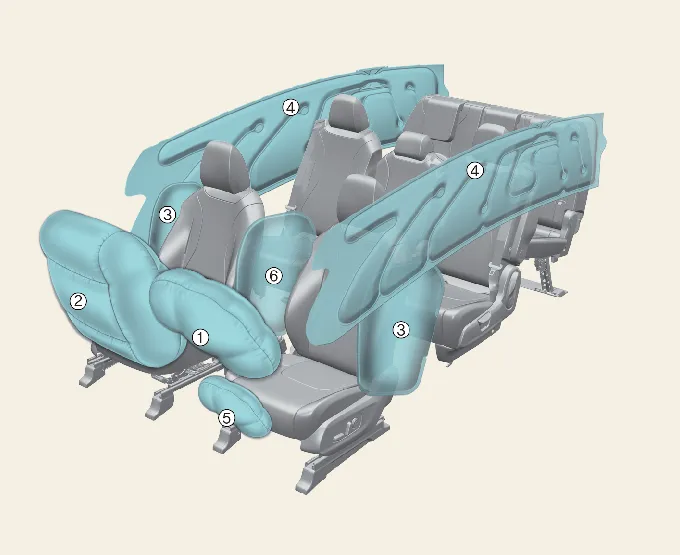
* Please note that the actual appearance and location of airbags in your specific Kia Carnival vehicle may differ
slightly from the provided illustration.
-
Driver's front air bag
-
Passenger's front air bag
-
Side air bag
-
Curtain air bag
-
Driver's knee air bag
-
Front center side air bag
Even though the Kia Carnival is equipped with an advanced airbag suite, it is mandatory that all occupants wear their
safety belts at all times. Airbags are classified as a Supplemental Restraint System (SRS); they are engineered to
act in concert with your seat belts, not as a replacement for them. Always remain buckled to minimize the risk and
severity of injuries during any collision or rollover event.
Supplemental Restraint System (SRS) components and functions
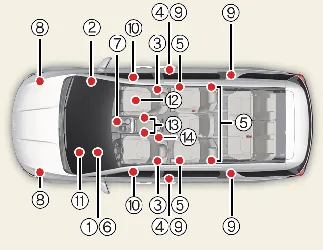
* Note: The actual physical positioning of SRS components within your Kia Carnival may vary slightly depending on the
specific model and trim configuration.
The Kia Carnival Supplemental Restraint System (SRS) is a sophisticated safety network consisting of the following
integrated components:
-
Driver's front air bag module
-
Passenger's front air bag module
-
Side air bag modules
-
Curtain air bag modules
-
Retractor pre-tensioner assemblies
-
Air bag warning light
-
SRS control module (SRSCM) and integrated rollover sensor
-
Front impact sensors
-
Side impact sensors
-
Side pressure sensors
-
Driver's knee air bag module
-
Occupant Detection System
-
Front driver/passenger's seatbelt buckle sensor
-
Front center side air bag module
The SRSCM acts as the "brain" of the safety system, continually monitoring all sensors whenever the ENGINE START/STOP
button is in the ON position, or for approximately 3 minutes following ignition off. This constant vigilance allows
the Kia Carnival to instantly determine if a frontal, near-frontal, or side impact meets the threshold severity
required to deploy the appropriate airbags or tighten the pre-tensioner seat belts.
Upon setting the ignition to ON, the SRS airbag warning light on your instrument panel will activate for
approximately 3 to 6 seconds as a self-diagnostic check. Once this cycle completes, the light should turn off,
indicating that the Kia Carnival safety systems are ready for operation.
 WARNING
If any of the following conditions occur, it indicates a potential malfunction of the SRS. In such an event, you must
have your Kia Carnival inspected immediately by an authorized Kia dealer:
-
The warning light does not illuminate briefly during the initial ignition-ON cycle.
-
The light remains illuminated after the standard 6-second diagnostic period.
-
The light triggers while the vehicle is in motion.
-
The light blinks when the ENGINE START/STOP button is in the ON position.
Driver's front air bag (1)
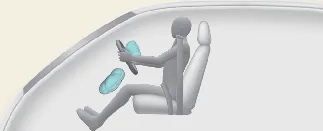
In the Kia Carnival, the front airbag modules are strategically located in the center of the steering wheel, within
the passenger-side dash panel above the glove box, and in the driver’s side knee bolster. When the SRSCM detects a
sufficiently severe frontal impact, it commands these modules to deploy instantly, creating a protective cushion for
the occupants.
Driver's front air bag (2)
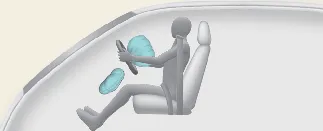
These modules feature specially engineered tear seams molded into the trim covers. Upon deployment, the rapidly
expanding airbag exerts internal pressure, causing these seams to separate cleanly. This allows the airbag covers to
open reliably, ensuring the bag can inflate to its full protective shape in milliseconds.
Driver's front air bag (3)
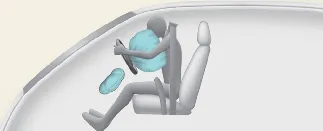
A fully deployed airbag, when utilized alongside a properly worn seat belt, serves to decelerate the driver's or
passenger's forward momentum during a crash. This action significantly reduces the risk of direct impact with the
steering wheel or the instrument panel in your Kia Carnival, while also distributing the kinetic force of the impact
more evenly across the body, which helps mitigate serious trauma.
Once the airbag has completed its inflation cycle, it immediately begins to deflate. This rapid deflation is
essential, as it allows the driver to maintain a clear line of sight, preserving their ability to steer the Kia
Carnival or engage other primary vehicle controls to safely bring the vehicle to a stop.
Passenger's front air bag
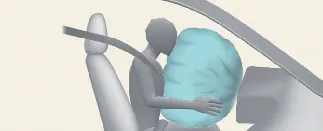
 WARNING: Air bag obstructions
Do not install, mount, or place any accessories on the steering wheel, the instrument panel, or the passenger-side
dashboard panel located above the glove box in your Kia Carnival. In the event of an airbag deployment, such objects
can be launched into the cabin at extremely high velocities, turning them into dangerous projectiles that could cause
severe injury.
 WARNING: Flying objects
Do not store any items, such as umbrellas, heavy bags, or tools, in the space between the front door and the front
seat. If the side airbag in your Kia Carnival is triggered, these items can be struck with significant force and
propelled into the interior, posing a direct threat to the occupants.
-
If an airbag deploys in your Kia Carnival, you may hear a loud bang followed by the appearance of fine dust
within the cabin. These conditions are normal and are not inherently hazardous; this fine powder is used to
keep the airbags packed and functional. While the dust may cause temporary skin or eye irritation—and
potentially aggravate asthma for some individuals—it is a standard byproduct. After an accident involving
airbag deployment, please ensure you wash all exposed skin areas thoroughly with cold water and a mild soap.
-
The Kia Carnival SRS remains active only when the ENGINE START/STOP button is in the ON position, or for
approximately 3 minutes after the ignition has been switched off. The system is considered to have a potential
malfunction if any of the following occur:
-
The SRS airbag warning light fails to appear during the initial system check.
-
The SRS airbag warning light remains illuminated continuously after the 3–6 second self-check window has
passed.
-
The SRS airbag warning light illuminates while you are driving the Kia Carnival.
Should any of these situations arise, please have your Kia Carnival inspected immediately by an authorized Kia
dealer to ensure the system is restored to peak working order.
 NOTICE
Always turn the ENGINE START/STOP button to the OFF position before you attempt to replace a fuse or disconnect a
battery terminal in your Kia Carnival. Never remove or replace any airbag-related fuses while the ENGINE START/STOP
button is in the ON position. Failure to follow this procedure will cause the SRS airbag warning light to trigger
erroneously, necessitating a professional reset at a service center.
Driver's and passenger's front air bag
To ensure maximum occupant safety, your Kia Carnival is equipped with an advanced Supplemental Restraint System
(SRS). This system features comprehensive protection, including front airbags and knee airbags for the driver, a
front passenger airbag, and integrated lap/shoulder safety belts at both primary seating positions.
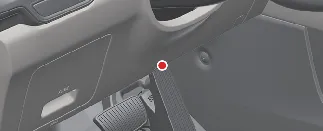
Driver's front air bag
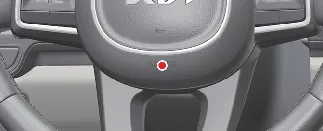
Driver's knee air bag
Passenger's front air bag
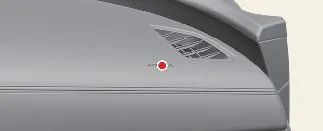
The presence of these safety features is clearly marked by "AIR BAG" lettering. You will find these identifiers on
the steering wheel pad cover, the driver's knee bolster panel located beneath the steering column, and the front
passenger's dashboard panel situated above the glove box.
The Supplemental Restraint System (SRS) in the Kia Carnival utilizes a network of airbags hidden beneath these
specific trim covers. Its primary purpose is to provide an additional layer of protection beyond what seat belts
alone can offer during a severe frontal collision. The system employs high-precision sensors to continuously monitor
impact severity and seat belt usage to optimize protection for the driver and front passenger.
A specialized seat belt buckle sensor determines if the front passenger is buckled, which is critical for the SRS
control module (SRSCM) to adjust deployment logic. This advanced Kia Carnival technology allows the SRS to tailor
airbag inflation in two stages: a lower-pressure first stage for moderate-severity impacts and a higher-pressure
second stage for more severe collision events. Always remember that failing to wear your seat belt correctly
drastically reduces the effectiveness of these safety systems and increases the risk of injury.
Furthermore, your Kia Carnival includes an Occupant Detection System (ODS) in the front passenger seat. This system
identifies whether the seat is occupied and can automatically deactivate the passenger airbag under specific
conditions, such as if a child or a light object is detected, to prevent unnecessary or harmful deployment.
 WARNING
Any unauthorized modification to the seat structure or safety system can cause the airbags to deploy at incorrect
pressure levels. While Kia provides a contact point for vehicle modifications required for persons with disabilities
(Customer Assistance: 1-800-333-4542 in the U.S.), Kia does not endorse or support any aftermarket changes that could
affect the advanced SRS or ODS functionality.
 WARNING: Replacement/modifications
The front passenger seat, dashboard, and door assemblies are critical components of the safety system. These should
only be replaced or serviced by an authorized Kia dealer using genuine Kia parts. Using non-original components or
improper replacement methods will compromise the Occupant Detection System and the overall performance of the
advanced airbags in your Kia Carnival.
Advanced airbags are designed to work in tandem with pre-tensioner seat belts. Please note that frontal airbags are
not intended to deploy in every accident, particularly in cases where the seat belt system provides sufficient
protection, or in side-impact, rear-impact, and rollover scenarios that lack the necessary frontal force threshold.
 NOTICE
Airbags are single-use safety devices. If an airbag has deployed, it must be replaced immediately by an authorized
Kia dealer to restore the vehicle to a safe operating state.
 WARNING: SRS wiring
Never tamper with, cut, or disconnect SRS wiring or internal components. Any interference can lead to accidental
deployment or render the safety system completely inoperative, leaving occupants unprotected in a crash.
 WARNING: No attaching objects
To avoid severe injury during a deployment event, never place objects—such as phone holders, cup holders, perfume, or
stickers—on or near the airbag covers on the steering wheel, instrument panel, windshield, or passenger dashboard.
Never place items between yourself and the airbag. Additionally, do not insert any objects into the small openings
near the side airbag labels on the seats, as these obstructions can dangerously interfere with the rapid inflation of
the Kia Carnival safety systems.
Side air bags and front center side air bag
Your Kia Carnival is equipped with advanced safety features, including side airbags integrated into each front seat,
as well as a front center side airbag located in the driver's seat to provide enhanced occupant protection.
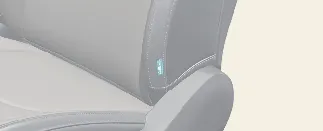
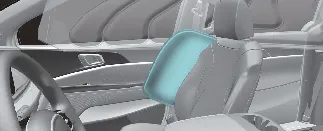
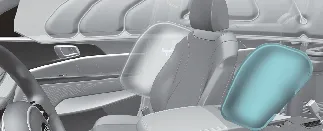
* Note: The actual appearance and configuration of the airbags in your vehicle may differ slightly from the provided
illustrations.
The primary purpose of these supplemental airbags is to provide the driver and front passenger of the Kia Carnival
with a critical layer of protection that exceeds the capabilities of seat belts alone.
-
The side airbags and the front center side airbag are engineered to deploy during specific side-impact
collisions, with deployment timing and pressure optimized based on the severity of the crash.
-
Depending on the collision dynamics, the side airbags may deploy on the side of the impact, or on both sides if
conditions necessitate.
-
If the vehicle's sensors detect a rollover or an imminent rollover scenario, the curtain airbags, side airbags,
and/or the front center side airbag will deploy to help secure occupants.
-
Please be aware that these airbags are not intended to deploy in every possible side-impact or rollover
incident, as deployment depends on specific crash parameters.
 WARNING: Unexpected deployment
To prevent the side airbags from deploying unexpectedly, avoid striking or applying impact force to the areas
where the side impact sensors are located while the ENGINE START/STOP button is in the ON position.
-
The side and front center side airbags are supplemental to your seat belt system; they are not a replacement.
Your seat belts must be fastened correctly at all times while the Kia Carnival is in motion to ensure maximum
effectiveness of the safety network.
-
For optimal protection and to avoid potential injury from a rapidly deploying airbag, both front occupants must
maintain an upright seating position with seat belts properly adjusted. The driver should keep their hands on
the steering wheel at the 9:00 and 3:00 positions, while the passenger's arms and hands should remain in their
lap.
 WARNING: Deployment interference
Do not install unauthorized accessories, such as aftermarket seat covers, on or near the side airbag modules,
as these can severely obstruct or alter the deployment path and timing of the airbags.
-
If you notice any damage to the seat fabric or the side airbag area, please have your Kia Carnival inspected
and repaired immediately by an authorized Kia dealer.
 WARNING: Flying objects
Never store items—such as umbrellas, heavy bags, or tools—in the space between the front door and the front seat. If
the side airbag in your Kia Carnival inflates, these objects can be launched as dangerous projectiles, posing a
significant risk of injury.
 WARNING: No attaching objects
-
Do not place any objects over the airbag modules or between the airbag and yourself. Avoid attaching items to
the door panels, side window glass, or front and rear pillars where the airbags deploy.
-
Do not tuck objects between the side airbag label and the seat cushion, as this can interfere with the system
during a high-severity collision.
-
Never insert any objects into small openings or seams near the side airbag labels. During inflation, these
items can cause the airbag to deploy unpredictably, leading to potential accidents or bodily harm.
-
Avoid installing any custom accessories in the immediate vicinity of the Kia Carnival side airbag modules.
Curtain air bag
The curtain airbags in your Kia Carnival are strategically positioned along the entire length of the roof rails,
spanning both sides of the cabin above the front and rear doors. These safety components are engineered to provide
comprehensive head and upper body protection for all outboard passengers.
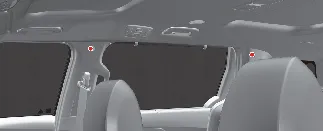
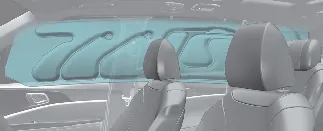
* Note: The actual configuration and visual representation of the airbags in your specific vehicle model may differ
slightly from these illustrations.
These curtain airbags are specifically designed to safeguard occupants during significant side-impact collisions.
Furthermore, they act as a critical safety barrier to help prevent occupant ejection from the Kia Carnival during
rollover events, particularly when all passengers are properly restrained by their seat belts.
-
Curtain airbags are programmed to deploy during certain side-impact scenarios, with activation timing based on
the detected crash severity. In some specific cases, such as an intense front-impact that meets the
side-deployment threshold, these airbags may also trigger.
-
Depending on the direction of the impact, the curtain airbags may deploy only on the affected side or, in more
severe incidents, across both sides of the Kia Carnival.
-
To ensure maximum safety during a rollover, the curtain airbags on both sides of the vehicle will deploy
simultaneously if the system detects an actual or imminent rollover condition.
-
Please note that these airbags are not intended to deploy in every possible collision or rollover incident; the
system's logic determines deployment based on a complex analysis of sensor data.
To maximize the protection provided by the Kia Carnival curtain airbags, it is essential that passengers remain
properly seated. Do not allow passengers to lean their heads or bodies against the doors, rest their arms on the
window frames, extend their limbs out of the window, or place any objects between their body and the door panels in
positions equipped with side and curtain airbags.
 NOTICE
Never attempt to open, dismantle, or repair any components related to the side and curtain airbag system. Any
inspection, maintenance, or repair must be conducted exclusively by an authorized Kia dealer to ensure the system
remains fully functional and reliable.
 WARNING: No attaching objects
-
Do not place any items over the airbag modules. Additionally, avoid attaching or securing any objects—such as
stickers, organizers, or decorations—in the area where the airbag inflates, including the door panels, side
glass, front and rear pillars, and roof side rails of the Kia Carnival.
-
For safety reasons, never hang hard, breakable, or heavy items on the cabin coat hooks, as these could become
hazardous projectiles in the event of an airbag deployment or a sudden vehicle maneuver.
Air bag collision sensors
The safety of the Kia Carnival relies on a sophisticated network of collision sensors that monitor driving conditions
in real-time. These sensors provide the data necessary for the Supplemental Restraint System (SRS) to make
split-second decisions regarding airbag deployment.
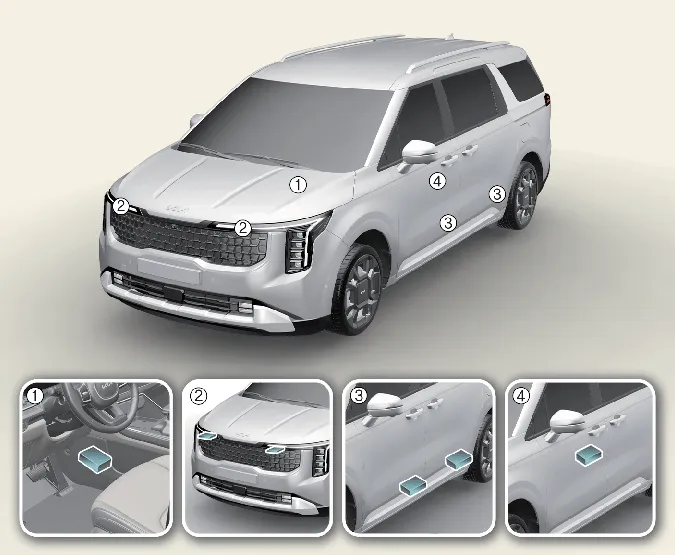
* Note: The exact shape and mounting position of these sensors may vary depending on your specific Kia Carnival
production configuration.
-
SRS Control Module (SRSCM) and Rollover Sensor: The "brain" of the safety system that
processes sensor data.
-
Front Impact Sensors: Located in the front end to detect decelerative forces during a frontal
collision.
-
Side Impact Sensors (B/C-pillars): Strategically placed to detect lateral impact forces.
-
Side Pressure Sensors: Integrated into the front doors to provide rapid detection of
side-impact pressure changes.
 WARNING: Air bag sensors
-
Do not strike, vibrate, or allow heavy objects to impact the specific areas where the Kia Carnival airbag
sensors are installed. Any physical damage to these zones can cause unexpected airbag deployment, leading to
severe personal injury or death.
-
The accuracy of the SRS is highly dependent on the precise installation angle and positioning of these sensors.
Any modification or damage to the mounting points can cause the system to fail—either by not deploying when
needed or by deploying unnecessarily. For this reason, never attempt DIY maintenance around these sensors;
always consult an authorized Kia dealer.
-
Avoid touching or tampering with the front impact sensors. Even a slight deviation in their orientation can
compromise the entire airbag system's functionality.
 WARNING: If equipped with rollover sensor
If your Kia Carnival features side and curtain airbags, it is equipped with a rollover sensor. Before towing the
vehicle, always set the ENGINE START/STOP button to OFF or ACC, and wait at least 3 minutes. This delay prevents the
system from misinterpreting the towing process (which may involve lifting or tilting) as a rollover event, which
could cause an unintended deployment of the side and curtain airbags.
Significant structural deformation—such as damage to the front bumper, front-end module, body panels, or doors—can
permanently misalign these critical sensors. If your Kia Carnival has sustained such damage, have the vehicle
inspected immediately by an authorized Kia dealer.
Furthermore, be aware that installing aftermarket accessories like non-genuine bumper guards, running boards, or side
steps can interfere with sensor performance. Always prioritize Kia Genuine accessories, which are rigorously tested
to ensure they do not adversely affect your Kia Carnival airbag deployment performance.
Supplemental Restraint System (SRS) care
The Supplemental Restraint System (SRS) in your Kia Carnival is engineered to be virtually maintenance-free. Because
this system contains sensitive, high-precision components, there are no parts within the SRS that can be safely
serviced or adjusted by the vehicle owner.
To ensure your Kia Carnival remains safe, monitor the SRS airbag warning light on your instrument cluster. If the
warning light fails to illuminate during the system check or stays on continuously while driving, have your vehicle
inspected immediately by an authorized Kia dealer.
Any service procedures involving the SRS—including removing, installing, or repairing components such as the steering
wheel, front passenger dashboard panel, front seats, or roof rails—must be performed exclusively by an authorized Kia
dealer. Improper handling of these safety systems can lead to unintended deployment or system failure, which may
result in serious personal injury.
When cleaning the interior, particularly the surfaces covering the airbag modules, use only a soft, dry cloth or a
cloth lightly dampened with plain water. Avoid using harsh chemical solvents, heavy-duty degreasers, or all-purpose
cleaners, as these substances can degrade the material of the airbag covers, potentially compromising the proper and
timely deployment of the system during a collision.
If any components of the airbag system require disposal, or if the Kia Carnival reaches the end of its service life
and must be scrapped, specific safety precautions must be followed to prevent accidental activation. Your authorized
Kia dealer is fully trained in these protocols and can provide the necessary guidance. Failure to adhere to these
safety procedures could significantly increase the risk of bodily injury.
 WARNING: Tampering with SRS
Never attempt to tamper with, modify, or disconnect any SRS wiring or integrated components. Such interference can
trigger an accidental inflation of the airbags or render the entire safety system inoperative, leaving you and your
passengers unprotected in the event of an accident.
 WARNING: Towing vehicle
Before having your Kia Carnival towed, always ensure the ignition is set to the OFF position and wait for at least 3
minutes. The side and curtain airbag sensors are highly sensitive to vehicle attitude; if the vehicle is tilted
during the towing process while the system is still active, the rollover sensors could incorrectly interpret the
motion as an emergency event, leading to the unexpected deployment of the side airbags.
Recap of important safety precautions
To ensure the safety of all occupants while traveling in your Kia Carnival, please adhere strictly to these
fundamental safety guidelines. Proper posture and the correct use of safety systems are essential to minimize the
risk of injury in the event of a collision or emergency maneuver.
-
Never permit passengers to occupy the cargo area or sit on top of folded-down rear seats. Every occupant in the
Kia Carnival must sit in an upright position, positioned fully back against their seat, with seat belts
properly fastened and both feet firmly planted on the floor.
-
Passengers must remain seated and refrain from changing seats while the vehicle is in motion. Unrestrained
individuals—or those moving about the cabin—are at extreme risk of being thrown against interior surfaces,
striking other passengers, or being ejected from the vehicle during a crash or sudden emergency stop.
-
Every seat belt is engineered to safely restrain exactly one person. Never attempt to share a single seat belt
between multiple occupants, as this drastically increases the risk of fatal injuries during a collision.
-
Do not utilize unauthorized aftermarket seat belt accessories or adjusters. Devices marketed to "improve
comfort" or "reposition" the belt can dangerously degrade the protection provided by the Kia Carnival seat belt
system, significantly increasing the risk of serious injury in a crash.
-
Occupants should avoid placing hard, sharp, or heavy objects between themselves and any airbag deployment zone.
Carrying such items in your lap, in your hands, or in your mouth is extremely dangerous; if an airbag deploys,
these items can become projectiles or cause severe impact trauma.
-
Maintain a safe distance from all airbag module covers. All Kia Carnival occupants must sit upright and fully
back in their seats with their feet on the floor. Sitting too close to an airbag cover can cause severe injury
if the airbag inflates during an incident.
-
Never attach, stick, or place any objects on or near airbag covers. Items such as stickers, phone holders, or
dashboard covers can obstruct or alter the deployment path of the airbag, leading to system failure or
increased injury risk during operation.
-
Always double-check that all doors are fully latched before driving your Kia Carnival. An unlatched door
increases the risk of occupant ejection in the event of a rollover or collision.
Additional Safety Insight: Always ensure that the headrests are adjusted to the correct height for each
passenger. Proper headrest alignment is critical for preventing whiplash and other cervical spine injuries during
rear-end collisions. Regularly inspect your vehicle's safety belts and anchor points for signs of wear or damage to
ensure the continued reliability of your Kia Carnival safety systems.
-
Do not attempt to modify the front seats. Any unauthorized alterations could interfere with the critical
operation of the supplemental restraint system (SRS) sensing components or the side air bags, potentially
compromising your safety in the event of a collision.
-
Do not place any items under the front seats of your Kia Carnival. Storing objects in this area could obstruct
or damage the essential sensing components and sensitive wiring harnesses, which might lead to system
malfunctions.
-
For their protection, never hold an infant or a child on your lap while the vehicle is in motion. In the event
of a sudden stop or a crash, the child could be seriously injured or fatally harmed. All infants and children
must be properly secured in appropriate, age-specific child safety seats or fastened with seat belts while
seated in the rear.
 WARNING
-
Sitting improperly or assuming an "out-of-position" posture can be extremely dangerous. It may cause occupants
to be positioned too close to a deploying air bag, strike the interior structure, or be thrown from the Kia
Carnival, all of which may result in severe injury or death.
-
To maximize occupant protection, always sit upright with the seatback adjusted to a vertical position. Ensure
you are centered on the seat cushion with your seat belt correctly fastened, your legs comfortably extended,
and your feet firmly planted on the floor.
-
Additional Safety Note: Please ensure that no part of your body obstructs the air bag
deployment zones. Maintaining proper distance from the dashboard and door panels ensures that the advanced
safety systems of your Kia Carnival function exactly as intended during an emergency.
Adding equipment to or modifying your air bag-equipped vehicle
If you choose to modify your Kia Carnival by altering the frame, bumper system, front end, side sheet metal, or
vehicle ride height, be aware that these changes may adversely affect the operation of the air bag system. Always
consult with authorized technicians to ensure any modifications do not compromise the safety integrity of your
vehicle.
Air bag warning labels
Important air bag warning labels, some of which are mandated by the U.S. National Highway Traffic Safety
Administration (NHTSA), are prominently attached to the sun visors. These labels are designed to alert both the
driver and passengers to the potential risks associated with the air bag deployment system in the Kia Carnival.