Forward Collision-Avoidance Assist malfunction
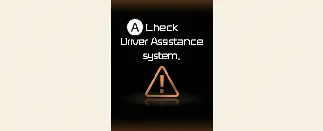
A: Check Driver Assistance system
If the Forward Collision-Avoidance Assist (FCA) system in your Kia Carnival is not functioning correctly, a warning
message will be displayed on the instrument cluster. Simultaneously, the Forward Safety warning light ( ), the Emergency Steering warning light (
 ), and the Master warning light (
 ) will illuminate to alert you of the fault. If these lights appear,
we strongly recommend visiting an authorized Kia dealer to have the system professionally inspected and repaired.
Forward Collision-Avoidance Assist disabled
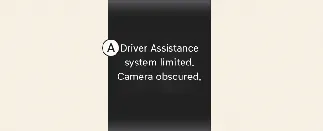
A: Driver Assistance system limited. Camera obscured.
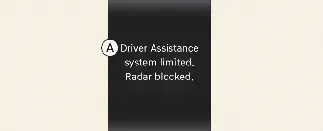
A: Driver Assistance system limited. Radar blocked.
The safety systems of your Kia Carnival rely on clear sensors to monitor the road. If the windshield area where the
front-view camera is mounted, or the front radar cover, bumper, or other sensor areas become covered with foreign
materials—such as heavy snow, mud, or rain—the system's detection performance will be significantly reduced.
Consequently, the Forward Collision-Avoidance Assist may be temporarily limited or completely disabled for your
safety.
When this blockage occurs, a warning message will appear, accompanied by the illumination of the Forward Safety
warning light ( ), the Emergency Steering warning light (
 ), and the Master warning light (
 ) on the cluster.
In most cases, the Forward Collision-Avoidance Assist will return to normal operation once the snow, rain, or other
debris is carefully removed from the sensor areas. However, if the Kia Carnival system continues to report a
malfunction after you have cleared all obstructions (including checking for attachments like trailers or carriers on
the rear bumper), please contact an authorized Kia dealer for a diagnostic inspection.
 WARNING
Please remain vigilant: even in scenarios where no specific warning message or light is illuminated on the cluster,
the Forward Collision-Avoidance Assist system may not operate perfectly under every driving condition. Always
maintain active control of your vehicle.
 NOTICE
You can conveniently monitor the real-time status of the Forward Collision-Avoidance Assist system at any time by
navigating to the "Service" message section within the utility information view on your Kia Carnival cluster display.
Limitations of Forward Collision-Avoidance Assist
While the Forward Collision-Avoidance Assist (FCA) system is designed to enhance your safety, there are specific
environmental and operational circumstances where the system in your Kia Carnival may not operate as intended, may
experience reduced performance, or may trigger an unnecessary alert. Always remain alert to your surroundings:
-
Sensor Obstruction: The front radar or front-view camera sensors are contaminated, blocked, or
physically damaged.
-
Extreme Temperatures: The environment surrounding the front-view camera or the front radar
system is subject to extreme high or low temperatures.
-
Windshield Interference: The camera's field of view is compromised by a tinted, coated, or
filmed windshield, or by physical obstructions like stickers, bugs, or cracks on the glass.
-
Environmental Conditions: Visibility is severely reduced due to heavy rain, snow, fog, or
accumulation of moisture and ice on the windshield.
-
Optical Interference: The camera's view is obstructed by intense sun glare or reflections from
wet road surfaces (such as puddles) that can confuse sensor interpretation.
-
Internal Reflections: Objects placed on the instrument panel may reflect in the windshield and
interfere with the camera's line of sight.
-
Lighting Transitions: The system struggles with rapid changes in illumination, such as when
your Kia Carnival enters or exits a tunnel, or when driving in environments that are excessively bright or
dark.
-
Visibility at Night: Detection capabilities are diminished in dark conditions if the headlamps
are obscured, off, or if the vehicle ahead lacks functioning taillights.
-
Partial Detection: Only a portion of the pedestrian, cyclist, or vehicle ahead is visible to
the sensors.
-
Large or Unusual Vehicles: The lead vehicle is a bus, a large truck with an atypical cargo
shape, or a trailer that does not reflect sensor signals in a standard way.
-
Irregular Vehicle Status: The front vehicle is tilted, overturned, or has an unusually high or
low ground clearance, making it difficult for the Kia Carnival system to classify the object.
-
Sudden Maneuvers: A vehicle, cyclist, or pedestrian suddenly cuts into your path, or the
vehicle ahead makes an abrupt lane change or emergency deceleration.
-
Radar Issues: The front radar is out of alignment, damaged, or physically impacted.
-
Empty Landscapes: Driving through areas with minimal structures or traffic density, such as
deserts or open meadows, which lack reference points for the radar.
-
Electromagnetic/Reflective Interference: Driving near metal-heavy zones like construction
sites, railroads, or areas with highly reflective surfaces like guardrails can cause false alerts.
-
Material Composition: The vehicle or bicycle ahead is constructed of or covered by materials
that do not effectively reflect radar signals.
-
Road Geometry: Navigating complex curves, roundabouts, or continuously driving in a circular
path where the lead vehicle may move out of the sensor's direct focus.
-
Vehicle Dynamics: You are driving with unstable steering inputs or are in the process of
departing from or returning to a lane.
Note: This list is not exhaustive. Always maintain a safe driving distance and remain ready to take manual
control of your Kia Carnival to ensure the highest level of safety.
-
The vehicle, motorcyclist, or powered two-wheeler ahead exhibits an unusual shape, making it difficult for the
Kia Carnival sensors to identify the object correctly.
-
The vehicle or motorcyclist in front is traversing a steep hill or incline, effectively moving out of the
optimal detection range of the Kia Carnival camera and radar systems.
-
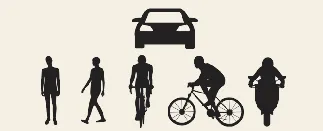
The illustration above identifies the types of objects that the Kia Carnival front-view camera and radar are
designed to recognize—including vehicles, motorcyclists, pedestrians, and cyclists. Please be aware that the
system may struggle to detect pedestrians or cyclists in the following circumstances:
-
The pedestrian or cyclist is leaning, crouching, or otherwise not maintaining an upright walking posture.
-
The individual is wearing specialized clothing or carrying equipment that obscures their human or cycle profile
from the Kia Carnival sensors.
-
The pedestrian or cyclist in front is moving at a speed that exceeds the system's tracking parameters.
-
The person is of short stature or is moving in a low-profile posture.
-
The individual has impaired mobility or is moving diagonally across the Kia Carnival driving path rather than
directly ahead.
-
There is a dense group, large crowd, or cluster of cyclists, which can overwhelm the sensor's ability to
differentiate individual targets.
-
The clothing worn by the pedestrian or cyclist matches the color or texture of the background, rendering them
nearly invisible to the system.
-
The pedestrian or cyclist is positioned near similarly shaped structures (like poles or signs), making it
difficult for the Kia Carnival to distinguish them from the surroundings.
-
You are navigating near busy intersections where pedestrians, cyclists, traffic signs, and various structures
are clustered together.
-
When driving in the following challenging environments:
-
Driving through dense steam, heavy smoke, or deep shadows.
-
Traveling through tunnels, underpasses, or iron bridges where lighting and radar reflections vary.
-
Driving in vast, open areas with few structural references (e.g., deserts, vast meadows, or barren
suburban landscapes).
-
Operating your Kia Carnival within a crowded or complex car park.
-
Driving through tollgates, active construction zones, bumpy roads, or over speed bumps that cause the
vehicle to vibrate.
-
Driving near areas with significant metal infrastructure, such as railroads or heavy construction sites,
which may cause radar interference.
-
Driving on sharply inclined or highly curved roads.
-
Passing through roadsides with dense, overgrown trees or frequent streetlights that cause flickering
light patterns.
-
Navigating narrow paths where vegetation is overgrown and obscures the road edge.
-
Areas with high electromagnetic interference, such as those with strong radio waves or high-voltage
electrical noise.
-
When the Kia Carnival is moving unstably or experiencing violent shaking.
-
If the vehicle height is severely tilted due to abnormal tire pressure, uneven loads, or excessive cargo
in the rear.
-
If non-standard equipment is installed, such as snow chains, a temporary spare tire, or wheels of an
incompatible size.
Junction Crossing, Lane-Change Oncoming, Lane-Change Side, Evasive Steering Assist function (if equipped)
The advanced safety suite in your Kia Carnival—including Junction Crossing, Lane-Change Oncoming, Lane-Change Side,
and Evasive Steering Assist—relies on high-precision radar sensors. Performance may be restricted or the system may
be temporarily limited under the following operational conditions:
-
Temperature Extremes: The ambient temperature surrounding the front or rear corner radar
sensors is outside of the optimal operating range.
-
Physical Obstructions: A trailer, rear carrier, or aftermarket bumper accessories (e.g.,
bumper guards, bike racks, or stickers) are installed near the radar sensors, obstructing their field of view.
-
Sensor Contamination: Radar sensors are covered with snow, mud, heavy rain, or road grime,
reducing their signal clarity.
-
Sensor Damage: The bumper area housing the radar sensors has sustained an impact, or the radar
units themselves have become misaligned or damaged.
-
External Blockage: The radar sensors are physically blocked by stationary objects such as
concrete walls, pillars, or neighboring vehicles while maneuvering.
-
Complex Road Geometry: Driving on highway/motorway ramps or roads featuring double-layered
guardrails or wall structures can lead to signal reflections and potential system confusion.
-
Proximity and Speed Dynamics: The system may experience limitations if another vehicle or
motorcyclist is driving in extreme proximity, passing at very high speeds, or if your Kia Carnival is passing
another vehicle rapidly.
-
Simultaneous Acceleration: If your Kia Carnival accelerates at the exact same moment as an
adjacent vehicle, the system may struggle to isolate the target.
-
Lane Complexity: The system may struggle if vehicles are shifting across multiple lanes
simultaneously or if the road layout is complex (e.g., changing number of lanes, crossing lane markings, or
wide/narrow lanes).
-
Target Classification Issues: Detection challenges occur with unusual vehicle types (e.g.,
flat trailers, buses, large trucks), vehicles with extremely low ground clearance (e.g., sports cars), or small
objects (e.g., pedestrians, animals, shopping carts).
-
Road Marking Ambiguity: Detection is hindered when lane markings are worn, indistinguishable
from the road surface, covered by puddles/oil, or obscured by shadows from trees or noise barriers.
-
Structural Substitution: In construction zones where temporary structures or zigzag patterns
substitute for standard lane lines, the Kia Carnival may require increased driver vigilance.
-
Unmarked Edges: Navigating roads without clear lane markings, such as those with only curbs or
natural road edges.
 NOTICE
For more comprehensive details regarding the detection limitations of the rear corner vehicle monitoring systems and
essential safety precautions concerning the maintenance of your Kia Carnival radar sensors, please refer to the "More
Details" section of your owner’s manual.
Limitations of Evasive Steering Assist
The Evasive Steering Assist function in your Kia Carnival may not operate as intended in the following specific
situations:
-
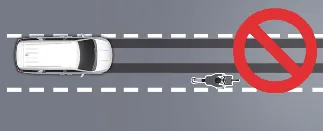
Outside Detection Range: The pedestrian or cyclist is positioned outside the system's active
operating area.
-
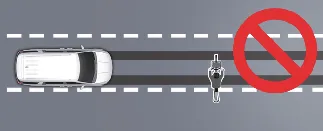
Lateral Movement: The pedestrian or cyclist is moving laterally (sideways) rather than
directly along the path of your Kia Carnival.
-
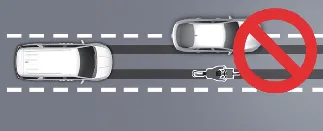
Insufficient Space: While the pedestrian or cyclist is within the operating area, there is
insufficient lateral space available for the Kia Carnival to perform a safe evasive steering maneuver.
 WARNING
-
Driving on a curved road:
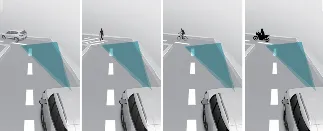
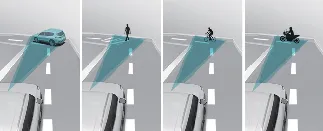
The Forward Collision-Avoidance Assist (FCA) system may struggle to detect obstacles on curved roads. You must
maintain a safe distance and be prepared to steer or brake manually. Additionally, the system may occasionally
misidentify objects in adjacent lanes as threats on a curve; always remain observant of your surroundings.
-
Driving on an inclined road:
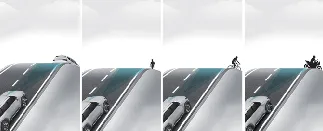
Uphill or downhill driving can adversely affect sensor performance. This may lead to unnecessary alerts or,
conversely, a failure to warn you of a collision risk. Always keep your eyes on the road and control the Kia
Carnival speed manually to maintain safety.
-
Changing lanes:
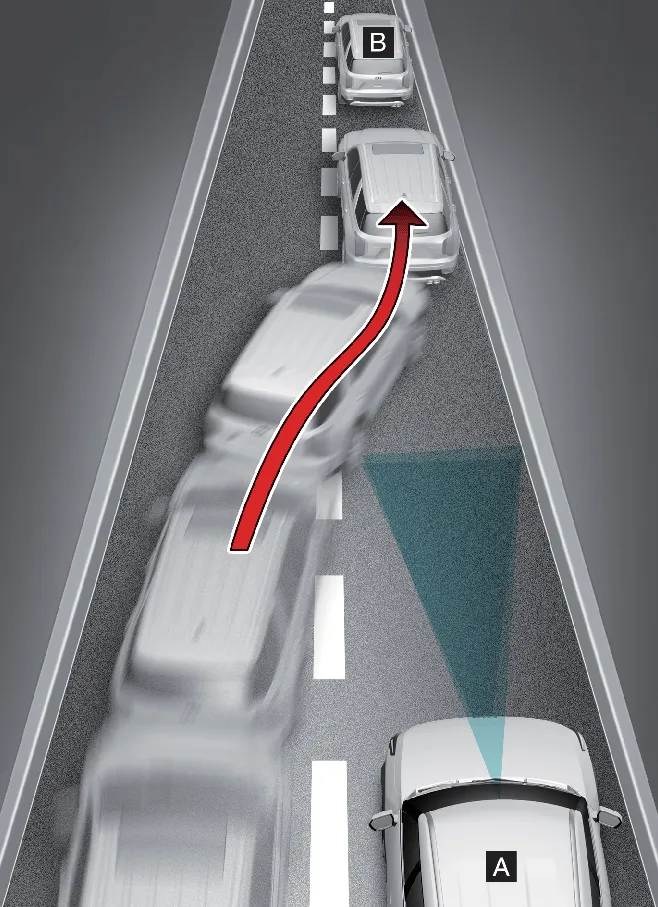
- Your vehicle
- Lane changing vehicle or motorcyclist
When another vehicle cuts into your lane abruptly, the Kia Carnival sensors require time to acquire the target.
Always maintain a safe braking distance. If a lead vehicle merges out, the system may also take a moment to
detect a new vehicle suddenly revealed in front.
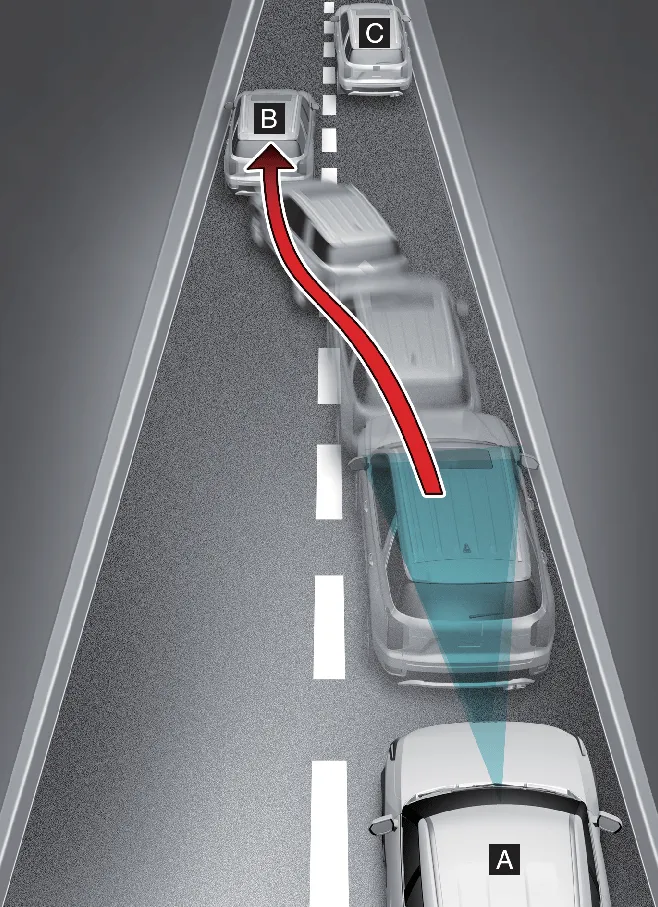
- Your vehicle
- Vehicle merging out
- Vehicle newly revealed in front
-
Detecting a vehicle with specialized cargo:
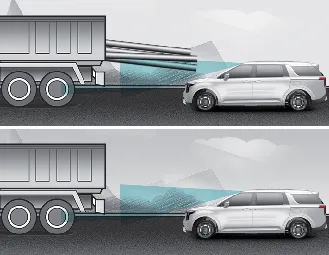
Be extra cautious when following vehicles with cargo extending rearward or vehicles with high ground clearance,
as the sensors may not accurately detect these extensions.
-
Towing: We recommend disabling the Forward Collision-Avoidance Assist when your Kia Carnival
is towing a trailer or another vehicle.
-
General Limitations: The system may be triggered by objects with shapes similar to vehicles or
pedestrians. Note that it does not actively operate on small wheeled objects like luggage, carts, or strollers.
Performance may be hindered by electromagnetic interference or during the 15-second initialization period after
the vehicle is started.
 NOTICE
For more detailed information regarding the detection limitations of the rear corner systems and safety cautions,
please refer to the "More Details" section of your manual.
This device complies with Part 15 of the FCC rules.
Operation of the electronics in your Kia Carnival is subject to the following three conditions:
-
This device may not cause harmful interference.
-
This device must accept any interference received, including interference that may cause undesired operation of
the system.
-
Changes or modifications to the equipment not expressly approved by the party responsible for compliance could
void the user's authority to operate the device.
This equipment complies with FCC radiation exposure limits set forth for an uncontrolled environment. To ensure
safety, this equipment should be installed and operated with a minimum distance of 8 inches (20 cm) between the
radiator (antenna) and your body.
This transmitter must not be colocated or operated in conjunction with any other antenna or transmitter within the
Kia Carnival.