Basic function
Warning and control
The core functions of the Forward Collision-Avoidance Assist (FCA) in your Kia Carnival operate through a multi-stage
approach to ensure safety:
-
Collision warning: Detecting and alerting the driver to potential risks.
-
Emergency braking: Automatically applying force to prevent or mitigate an impact.
-
Stopping vehicle and ending brake control: Bringing the vehicle to a controlled stop and
managing the release of brakes once safe.
Collision Warning
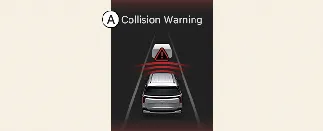
A: Collision Warning
The Kia Carnival Collision Warning system actively monitors the road ahead and can alert the driver using a
combination of visual, auditory, and tactile feedback. This includes the Forward Safety warning light blinking on the
instrument cluster ( ), an urgent message on the display, an audible
chime, and a distinctive vibration through the steering wheel.
The collision warning system in your Kia Carnival operates within the following speed ranges, depending on the nature
of the object detected:
Emergency Braking
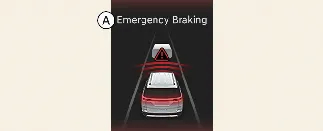
A: Emergency Braking
When the Emergency Braking system in your Kia Carnival identifies an imminent hazard, it proactively alerts the
driver. This alert sequence includes a blinking Forward Safety warning light ( ), a clear visual warning message on the cluster, an
audible chime, and tactile vibrations through the steering wheel.
This intelligent brake assist function is designed to intervene and help avoid or mitigate potential collisions with
other vehicles, pedestrians, cyclists, and powered two-wheelers.
Emergency braking in the Kia Carnival is dynamically activated based on the object detected and the level of danger
under the following conditions:
-
Vehicle or powered two-wheeler:
|
-
|
Driving target
|
Stopped target
|
|
Weak braking power
|
6~124 mph (10~200 km/h)
|
-
|
|
Strong braking power
|
6~80 mph (10~130 km/h)
|
6~53 mph (10~85 km/h) / (6~62 mph (10~100 km/h)*
|
*: If the Kia Carnival system determines that collision avoidance is difficult even by attempting a lane
change, the operation range may adjust. Please note that the effective operational range can fluctuate based
on environmental conditions and surroundings.
-
Pedestrian or cyclist: 6~40 mph (10~65 km/h)
 CAUTION
-
The effective range of the system may decrease depending on traffic density, road conditions, or external
surroundings around the Kia Carnival.
-
When driving at night, the system’s ability to recognize powered two-wheelers is reduced. Consequently, the Kia
Carnival Forward Collision-Avoidance Assist system may be temporarily limited or may not function as expected
under low-light conditions.
Stopping vehicle and ending brake control
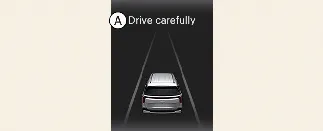
A: Drive carefully
If the Kia Carnival is brought to a full stop by the emergency braking system, a notification message will appear on
the instrument cluster to inform the driver.
For your safety and the safety of your passengers, the driver should immediately depress the brake pedal and
carefully scan the surrounding area before proceeding.
Junction Turning function
Warning and control
The Junction Turning function in your Kia Carnival operates via a comprehensive safety protocol consisting of the
following stages:
Collision Warning
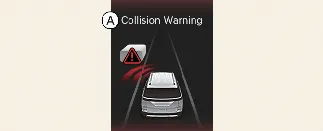
A: Collision Warning
The Junction Turning Collision Warning will alert the driver using a flashing Forward Safety warning light ( ), a warning message, an audible alarm, and steering wheel
vibrations to ensure immediate attention.
The collision warning system activates under the following specific parameters:
-
Your driving speed: Approximately 6-19 mph (10-30 km/h)
-
Oncoming vehicle speed: Approximately 19-44 mph (30-70 km/h)
-
Powered two-wheeler and cyclist speed: Approximately 9-44 mph (15-70 km/h)
Emergency Braking
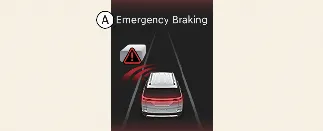
A: Emergency Braking
The Kia Carnival emergency braking system is designed to alert the driver effectively in high-risk scenarios. When a
potential threat is detected, the system triggers a blinking Forward Safety warning light ( ), displays an urgent warning message on the instrument
cluster, emits an audible chime, and initiates steering wheel vibration. This sophisticated brake assist feature
works to actively prevent or minimize the severity of collisions with oncoming vehicles, pedestrians, cyclists, and
powered two-wheelers.
Emergency braking in your Kia Carnival will be activated when the vehicle is operating under the following
conditions:
-
Your driving speed: 6~19 mph (10~30 km/h)
-
Oncoming vehicle speed: Approximately 19-44 mph (30-70 km/h)
-
Powered two-wheeler and cyclist speed: Approximately 9-44 mph (15-70 km/h)
Stopping vehicle and ending brake control
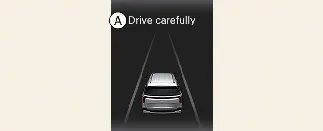
A: Drive carefully
In the event that your Kia Carnival is automatically brought to a halt by the emergency braking function, a clear
warning message will appear on the instrument cluster to notify the driver.
For your own safety and the safety of those around you, the driver should immediately depress the brake pedal to
maintain control and perform a thorough check of the vehicle's surroundings.
 NOTICE
When performing a right turn at an intersection, the Kia Carnival may provide braking assistance to help reduce the
risk of a collision if a cyclist is detected approaching from the opposite side at a speed of 10 to 20 km/h (6 to 12
mph).
Direct Oncoming function
Warning and control
The Direct Oncoming function within the Kia Carnival utilizes a multi-layered approach to ensure safety, operating in
the following ways:
Collision Warning
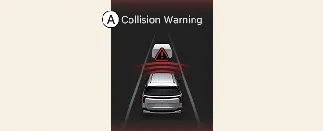
A: Collision Warning
The Collision Warning system notifies the driver of potential dangers by flashing the Forward Safety warning light
( ), showing an on-screen warning message, generating an audible
alert, and vibrating the steering wheel.
Collision Warning in the Kia Carnival may be activated under the following conditions:
-
Your driving speed: Approximately 19~80 mph (30~130 km/h) (or 6~80 mph (10~130 km/h) if
equipped with specific performance packages)
-
Oncoming vehicle or powered two-wheeler speed: Approximately above 6 mph (10 km/h)
Emergency braking
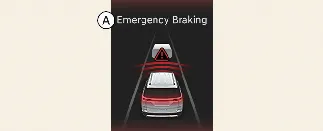
A: Emergency Braking
Emergency braking in your Kia Carnival serves as a final safety measure, alerting the driver through a blinking
forward safety warning light ( ), a dashboard warning message, audible tones, and steering
wheel feedback.
Emergency braking may be activated in the following conditions:
Stopping vehicle and ending brake control
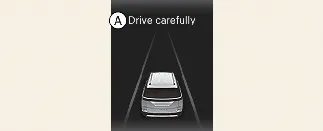
A: Drive carefully
In situations where the Kia Carnival is brought to a complete halt by the emergency braking system, a descriptive
warning message will be displayed on the cluster to alert the driver.
To ensure maximum safety, it is essential that the driver immediately depresses the brake pedal to maintain the
vehicle's stopped position and visually inspects the surrounding environment for any ongoing hazards.
 CAUTION
-
If your Kia Carnival or an approaching vehicle is not traveling in a straight line, the Front Oncoming function
may experience a delay in its warning and control sequences, or it may not operate as intended.
-
Operating your Kia Carnival at night can reduce the sensor performance regarding powered two-wheeler
recognition. During these conditions, the Forward Collision-Avoidance Assist system may be temporarily limited
or rendered inactive; please remain vigilant.
Junction Crossing function (if equipped)
Warning and control
The Junction Crossing function in the Kia Carnival is designed to operate through several distinct safety levels:
Collision Warning
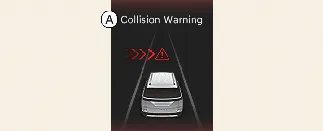
A: Collision Warning
The Kia Carnival will alert the driver to a potential collision using a combination of the flashing Forward Safety
warning light ( ), a dashboard warning message, an audible alarm, and steering
wheel vibrations.
This forward collision warning system may be activated under the following conditions:
Emergency Braking
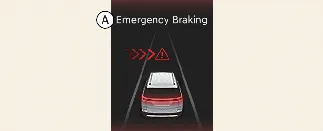
A: Emergency Braking
When the emergency braking system in your Kia Carnival initiates, the driver is alerted by a flashing Forward Safety
warning light ( ), a text notification, an audible tone, and steering wheel
vibration. This system is designed to assist in mitigating or completely avoiding collisions with vehicles,
pedestrians, cyclists, and powered two-wheelers.
Emergency braking for the Kia Carnival may be triggered in the following conditions:
Stopping vehicle and ending brake control
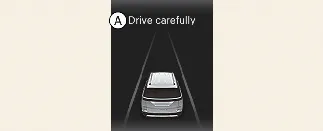
A: Drive carefully
Should the Kia Carnival be stopped due to an emergency braking event, a warning message will be provided on the
instrument cluster.
For optimal safety, the driver should manually depress the brake pedal without delay and carefully check all
surroundings before resuming travel.
 CAUTION
If the collision angle between the Kia Carnival and the crossing vehicle falls outside of the system's operational
range, the Junction Crossing warning and control features may be delayed or may not activate.
Lane-Change Oncoming function (if equipped)
Warning and control
The Lane-Change Oncoming function in your Kia Carnival is designed to enhance safety by monitoring traffic flow and
operates through the following sophisticated mechanisms:
Collision Warning
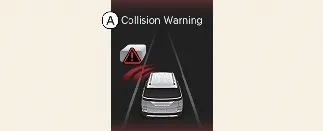
A: Collision Warning
When the system detects an impending collision, the Kia Carnival will immediately alert the driver. This alert
includes a blinking emergency steering warning light on the dashboard ( ), a clear visual warning message on the cluster, an
audible alert, and noticeable steering wheel vibrations to command your attention.
The collision warning system may be activated when your Kia Carnival meets the following operational criteria:
-
Your driving speed: Approximately 25~90 mph (40~145 km/h)
-
Oncoming vehicle or powered two-wheeler speed: Approximately above 6 mph (10 km/h)
-
Relative speed: Approximately below 124 mph (200 km/h)
Emergency Steering
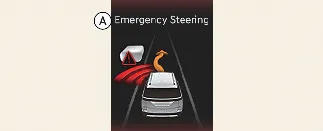
A: Emergency Steering
Emergency steering provides critical support to the driver. When activated, it utilizes the same blinking emergency
steering warning light ( ), dashboard messages, audible warnings, and steering wheel
vibrations. The system applies active steering assistance to help you steer clear of or mitigate the impact of a
collision with an oncoming vehicle or a powered two-wheeler.
Emergency steering will be activated in the following conditions:
-
Your driving speed: Approximately 25~90 mph (40~145 km/h)
-
Oncoming vehicle or powered two-wheeler speed: Approximately above 6 mph (10 km/h)
-
Relative speed: Approximately below 124 mph (200 km/h)
Lane-Change Side function (if equipped)
Warning and control
The Lane-Change Side function on the Kia Carnival operates through the following safety protocols:
Collision Warning
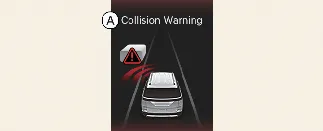

A: Collision Warning
If the system identifies a hazard, the Kia Carnival will alert the driver via the blinking emergency steering warning
light ( ), a warning message, auditory signals, and steering wheel
vibration. Additionally, a warning light will illuminate on the relevant outside rear-view mirror (side-view mirror)
whenever the Kia Carnival detects a vehicle or a powered two-wheeler approaching from the rear in either the left or
right lane.
Collision warning can be activated under the following conditions:
Emergency Steering
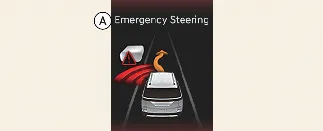
A: Emergency Steering
To proactively warn the driver that an emergency steering maneuver is about to be initiated, the Kia Carnival system
employs a multi-sensory approach. The emergency steering warning light will begin blinking ( ), a clear warning message will appear on the instrument
cluster, an audible chime will sound, and the steering wheel will provide haptic vibrations to alert the driver.
Additionally, a warning indicator on the corresponding outside rear-view (side-view) mirror will illuminate if the
Kia Carnival detects a vehicle or powered two-wheeler approaching from the rear in either adjacent lane. In critical
situations, steering assistance may be automatically applied to help avoid a collision.
Emergency steering in your Kia Carnival can be activated under the following conditions:
 CAUTION
-
The Lane-Change Side function will not operate if the oncoming vehicle or powered two-wheeler is stationary.
-
These specialized functions do not detect or react to flanking cars or two-wheeled vehicles that are already
stationary.
-
The detection range of the Kia Carnival’s front and rear-side radar sensors is calibrated for standard road
lane widths. On narrow roads, the system may trigger false warnings for vehicles in adjacent lanes; conversely,
on exceptionally wide roads, the sensors might fail to recognize a vehicle in the neighboring lane.
-
The lateral approaching vehicle response function is automatically deactivated in the following scenarios:
-
If you drive significantly past the lane markings into the next lane.
-
If you steer away from the direction of the potential collision risk.
-
If the steering wheel is rotated rapidly by the driver.
-
If you apply pressure to the brake pedal.
-
If the standard Forward Collision-Avoidance Assist (FCA) system is triggered.
-
After the lateral approaching vehicle response function has activated, or following a standard lane change,
ensure your Kia Carnival is positioned in the center of the lane. If you continue driving along the edge of the
lane, the system will deactivate to avoid unnecessary interference.
 NOTICE
-
If the Kia Carnival detects that an emergency steering maneuver might introduce additional accident risks, the
system may prioritize a collision warning only, rather than attempting an automatic steering assist.
-
System behavior is tailored to driver positioning: if the driver’s seat is on the left, collision warnings may
trigger during left turns; if the seat is on the right, warnings may trigger during right turns.
Evasive Steering Assist function (if equipped)
Warning and control
The Evasive Steering Assist function in your Kia Carnival operates via the following safety protocol:
Emergency Steering (Driver steering assist)
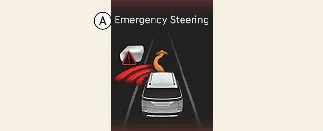
A: Emergency Steering
When the Emergency Steering system in your Kia Carnival identifies a potential road hazard, it promptly alerts the
driver. The notification sequence includes a flashing emergency steering warning light ( ), a clear visual warning message, an audible
chime, and tactile steering wheel vibrations to draw immediate attention to the situation.
If there is an imminent risk of collision with a vehicle, pedestrian, cyclist, or powered two-wheeler ahead, the Kia
Carnival system is designed to provide steering assistance. This support activates when the driver initiates a
steering maneuver to evade the obstacle, working in tandem with the driver’s input to help prevent a collision.
For optimal safety, the Emergency Steering function in the Kia Carnival is calibrated to activate under the following
specific operational conditions: